Here is a comprehensive chronicle of the complete history of Paris Saint-Germain Football Club.
The Complete Chronicles of Paris Saint-Germain Football Club: 1970–2026
Introduction: The Parisian Football Void (Pre-1970)
To understand why Paris Saint-Germain (PSG) was created, one must understand the unique, anomalous state of French football in the 1960s. Unlike London, Madrid, Rome, or Buenos Aires, the “City of Light” did not possess a dominant football team. Historically, teams like Racing Club de France and Red Star had enjoyed brief spells of success, but by the late 1960s, Paris had become a relative wasteland for elite-level football. The major powerhouses of the French game were located in the industrial regions or southern provinces: AS Saint-Étienne, Olympique de Marseille, Stade de Reims, and FC Nantes.
For a capital city of millions, this was seen as both a cultural failure and a significant commercial vacuum. The French Football Federation (FFF) and a group of ambitious, wealthy investors recognized that a city like Paris desperately needed a club capable of filling stadiums, attracting television rights, and representing France on the grand European stage.
Chapter 1: The Genesis and “The Great Divorce” (1970–1973)
The Merger of 1970
In 1969, an association of prominent businessmen led by Guy Crescent, Pierre-Étienne Guyot, and Henri Patrelle launched an ambitious drive to create a brand-new elite team. They initially formed an entity known simply as Paris Football Club (Paris FC). However, Paris FC had a major problem: it was a team on paper, possessing financial backing and ambition but no infrastructure, no league place, and no players.
To fast-track their way into the upper echelons of the French pyramid, the directors looked toward the suburbs. Just a few miles west lay Stade Saint-Germain, a respected club founded in 1904 based in Saint-Germain-en-Laye. Stade Saint-Germain had just earned promotion to the Championnat de France Professionnel (the second division) and boasted a functional stadium, Camp des Loges, alongside a roster of competitive players and a passionate local following.
On August 12, 1970, the merger was finalized. The marriage of Paris FC’s financial ambition and Stade Saint-Germain’s sports infrastructure birthed Paris Saint-Germain Football Club. Pierre-Étienne Guyot was named the club’s first president, while the legendary French midfielder Jean Djorkaeff became the team’s first captain on the pitch.
Rapid Ascent and Sudden Splintering
PSG’s inaugural season (1970–71) was an unmitigated success. Playing in the National (Division 2), the newly formed club immediately won the championship, securing promotion to the top tier, Division 1 (now Ligue 1). The capital city finally had its top-flight team, and crowds flocked to see them.
However, the political foundations of the club were deeply unstable. The municipal council of Paris, which held significant sway over public funding and the usage of the newly reconstructed Parc des Princes stadium, grew deeply uncomfortable with the club’s suburban identity. They demanded that the club strip “Saint-Germain” from its name to receive crucial subsidies and gain access to the Parc des Princes, aiming for a purely urban, central Parisian identity.
President Henri Patrelle fiercely resisted this change, citing the proud history of Stade Saint-Germain. The disagreement escalated into an ideological civil war, leading to “The Great Divorce” of May 1972.
The club was severed into two entities:
- Paris FC: Retained the first-division status, the professional roster, and municipal financial backing.
- Paris Saint-Germain: Relegated to the amateur third tier (Division 3), keeping only the name, administrative identity, and the suburban training ground at Camp des Loges.
Most contemporary observers assumed Paris FC would become the definitive face of capital city football, while PSG would fade into lower-league obscurity. History proved to be precisely the opposite.
Chapter 2: The Daniel Hechter Era and the Birth of Modern Identity (1973–1978)
The Fashion Revolution
Stranded in the third tier, PSG needed a savior. He arrived in the form of Daniel Hechter, a highly successful, glamorous French fashion designer. Hechter gathered a consortium of wealthy, culturally influential figures—including actor Jean-Paul Belmondo, music producer Francis Borelli, and businessman Jacky Bloch—to invest in the club. Hechter took over as chairman of the management committee in 1973.
Hechter understood that football was not merely an athletic contest; it was a form of entertainment and identity. He personally designed the club’s iconic home jersey: a deep blue shirt flanked by a bold, central vertical red stripe, bordered by thin white lines. The colors intentionally blended the red and blue of the city of Paris with the white of Saint-Germain-en-Laye. This kit design remains one of the most instantly recognizable and celebrated uniforms in global football history.
   +---------------------------------------+
   |   BLUE   | W |   RED   | W |   BLUE   |
   |          | H |         | H |          |
   |          | I |         | I |          |
   |          | T |         | T |          |
   |          | E |         | E |          |
   +---------------------------------------+
     The Iconic "Hechter Jersey" Layout (1973)
The Return to the Light
Under Hechter’s guidance, the club moved aggressively to regain professional status. He hired the legendary French striker Just Fontaine—the record holder for the most goals scored in a single World Cup—as the club’s sporting director. Fontaine’s tactical acumen and Hechter’s resources quickly bore fruit.
PSG achieved promotion back to the second division, and in the 1973–74 season, they faced a high-stakes promotion playoff against Valenciennes. PSG triumphed, securing their return to Division 1. Ironically, in the very same week that PSG won promotion back to the top flight, their estranged sister club, Paris FC, was relegated from it. PSG moved into the Parc des Princes in 1974, establishing the stadium as their spiritual home. They have never relinquished their top-flight status since that day, making them the longest-consecutively serving club in the history of Ligue 1.
Despite establishing themselves as an entertaining, attack-minded top-flight outfit with stars like Algerian maestro Mustapha Dahleb and flying winger Jean-Pierre Tokoto, Hechter’s era ended in scandal. In January 1978, he was handed a lifetime ban from football by the French federation following a corruption probe involving a double-ticketing scheme at the Parc des Princes designed to generate under-the-table bonuses for players. Hechter departed, but he had successfully given PSG its soul, its stadium, and its style.
Chapter 3: The Francis Borelli Era—First Taste of Silverware (1978–1991)
Following Hechter’s sudden exit, his vice president, Francis Borelli, assumed the presidency. Borelli was a dramatic contrast to Hechter; he was a romantic, deeply emotional man who famously kissed the pitch of the Parc des Princes during moments of high tension. He would govern the club for over a decade, overseeing a period of consolidation, emotional highs, and the very first major trophies in the club’s cabinet.
The Cup Kings
By the early 1980s, Borelli had assembled a highly competitive squad mixed with rugged French defensive talent and exceptional international flair. The crown jewel of this team was Safet Sušić, a Yugoslavian playmaker widely regarded as one of the most naturally gifted creative midfielders of his generation. Alongside Sušić were stars like Dominique Rocheteau (the “Green Angel” signed from Saint-Étienne), forward Toko, and tough-tackling midfielder Luis Fernandez.
PSG’s maiden major success arrived on May 15, 1982, in the final of the Coupe de France against the dominant team of the era, AS Saint-Étienne, led by Michel Platini. In front of an electric Parc des Princes crowd, the match ended 2–2 after extra time, with Rocheteau scoring an equalizer in the dying seconds of the added period. PSG triumphed in a tense penalty shootout, giving the capital city its first major footballing trophy in decades.
The club proved this was no fluke by retaining the Coupe de France the following year, defeating Nantes 3–2 in an absolute classic 1983 final, highlighted by a breathtaking individual goal from José Touré.
The First League Title (1985–86)
While the club had established itself as an elite cup-competition specialist, the league title had continuously eluded them. That changed in the 1985–86 season under the meticulous management of a young Gérard Houllier, who would later go on to achieve international fame with Liverpool.
Houllier instilled a sense of tactical discipline, defensive solidity, and physical fitness that had historically been lacking in the flashy Parisian sides. Anchored by goalkeeper Joël Bats and marshaled in midfield by Fernandez and Sušić, PSG embarked on a historic 26-match unbeaten run, cruising to their first-ever Division 1 championship. The title solidified PSG’s status as a true heavyweight of the French game, breaking the regional hegemony of provincial clubs.
   1985-86 PSG Championship Foundation:
   [Bats] -> [Pilorget / Jeannol] -> [Fernandez] -> [Sušić] -> [Rocheteau]
Stagnation and Financial Woes
The euphoria of the 1986 title was followed by a prolonged period of hangover and regression. As the late 1980s progressed, Olympique de Marseille, backed by the aggressive and controversial tycoon Bernard Tapie, rose to become the dominant, wealthy superpower of French football. PSG found it impossible to match Marseille’s financial muscle or political influence.
Borelli’s traditional, romantic style of management struggled to cope with the rapid commercialization and inflating player wages of modern football. By 1990, PSG was drowning in crippling debts, facing structural deficits, and sliding down the league table into mediocrity. The club was on the verge of bankruptcy and desperately required another structural reinvention.
Chapter 4: The Canal+ Golden Era (1991–2006)
The Television Revolution
In May 1991, French premium television broadcaster Canal+ purchased Paris Saint-Germain, orchestrating one of the most significant institutional takeovers in French sports history. Canal+ viewed the club as premium content for its subscription channels and possessed the capital needed to challenge Bernard Tapie’s Marseille.
Michel Denisot, a prominent television executive, was appointed as the club’s president. Denisot brought a slick, professional corporate approach to the club, immediately clearing all outstanding debts and providing an unprecedented war chest for player acquisitions.
The transformation of the squad was immediate and spectacular. Over a brief window, PSG signed:
- George Weah: A powerhouse Liberian striker signed from Monaco, possessing immense pace, power, and technical skill.
- David Ginola: A charismatic, elegant French winger who captured the imagination of fans with his dribbling ability.
- Valdo: A subtle, highly intelligent Brazilian international playmaker.
- Bernard Lama: A spectacular, acrobatic goalkeeper who perfectly replaced Joël Bats.
- Raí: The captain of the Brazilian national team, an elegant, towering attacking midfielder who would become an all-time club legend.
The Clásico Rivalry & Domestic Glory
Under the managerial guidance of Artur Jorge, PSG quickly built a team designed to play physical, tactically rigorous football. The rivalry between PSG and Olympique de Marseille was intentionally amplified by Canal+ and Bernard Tapie to create a high-stakes, dramatic television spectacle. This fixture became known as “Le Classique”, characterized by intense fan hostility, packed stadiums, and fiercely aggressive matches on the pitch.
In the 1993–94 season, PSG swept aside all competition to win their second Division 1 title, finishing comfortably ahead of Marseille. The team played a brilliant brand of balanced football, with George Weah leading the line ruthlessly and Raí establishing himself as the creative heartbeat of the team.
                  Lama
    Sassus   Guerin   Roche   Colleter
                 Le Guen
         Bravo             Valdo
                   Raí
             Weah       Ginola
     Tactical Blueprint: The 1993-94 Title Squad
The European Kings (1995–1997)
The true hallmark of the Canal+ era was not merely domestic titles, but an extraordinary, sustained run of success in European competitions. PSG developed a reputation as one of the most feared knockout teams in Europe, reaching five consecutive European semifinals between 1993 and 1997 across the UEFA Cup, the UEFA Champions League, and the European Cup Winners’ Cup.
They famously eliminated European royalty during this run, including legendary aggregate victories over Real Madrid (highlighted by an iconic 4–1 comeback win at the Parc des Princes in 1993) and Johan Cruyff’s Barcelona FC in the 1995 Champions League quarterfinals.
The absolute pinnacle of this golden era came under the management of former player Luis Fernandez in the 1995–96 season. On May 8, 1996, in Brussels, PSG faced Austrian side Rapid Vienna in the final of the UEFA Cup Winners’ Cup. A long-range, deflected free-kick from center-back Bruno N’Gotty secured a 1–0 victory. PSG became only the second French club in history to hoist a major European trophy.
The following season (1996–97), under manager Ricardo Gomes, the club reached the final of the same competition once again, narrowly losing 1–0 to a star-studded Barcelona side featuring Ronaldo Nazário.
The Decline and the Ronaldinho Interlude
As the late 1990s transitioned into the early 2000s, the Canal+ model began to fracture. Bad transfer decisions, expensive failures (such as the massive signing of Nicolas Anelka), and structural changes within television broadcasting meant that funding began to dry up. The club entered a period of extreme inconsistency, regularly changing managers and failing to mount serious title challenges in Ligue 1, which was now dominated by the historic seven-year title reign of Olympique Lyonnais.
Yet, even during this period of decline, PSG remained a theater for world-class entertainment. In 2001, the club signed a young, rising Brazilian talent from Grêmio named Ronaldinho.
For two seasons, Ronaldinho illuminated the Parc des Princes with his breathtaking skill, audacious dribbling, and famous performances against bitter rivals Marseille. Although the team around him was deeply flawed and failed to win major trophies, Ronaldinho’s spell in Paris cemented the club’s historical connection with world-class Brazilian artists.
Chapter 5: The Dark Years of Instability (2006–2011)
In 2006, Canal+ decided to exit the football landscape entirely, selling Paris Saint-Germain to an investment consortium consisting of American private equity firm Colony Capital, French investment firm Butler Capital Partners, and Morgan Stanley. Colony Capital eventually took majority control of the institution.
This era is widely remembered by the club’s faithful as one of the darkest, most stressful periods in its history, characterized by deep financial distress, violent stadium unrest, and terrible performance on the pitch.
The Brink of Disaster
Free from the heavy backing of a television network, the club’s finances deteriorated rapidly. The quality of the roster collapsed, and the team found itself routinely mired in the bottom half of Ligue 1.
The lowest point came during the 2007–08 season. Managed by Paul Le Guen, a team featuring aging stars like Pauleta (the prolific Portuguese striker who became a cult hero for his loyalty) and young prospects spent the entire season in a terrifying relegation battle. Had PSG dropped into Ligue 2, the financial consequences could have permanently dismantled the club. On the final matchday of the season, a tense, nerve-shredding 2–1 away victory against Sochaux, courtesy of a brace from Amara Diané, miraculously saved the club from relegation.
   2007-08 Ligue 1 Relegation Battle Final Day:
   [Sochaux 1 - 2 PSG] -> Diané (11', 83') saves the club from dropping to Ligue 2.
Hooliganism and Stadium Crisis
Compounding the problems on the pitch was a severe, toxic culture war in the stands of the Parc des Princes. The stadium was deeply divided between two rival ultra fan groups occupying opposite ends of the ground: the Boulogne Boys (Kop de Boulogne) and the Virage Auteuil.
These two factions developed fierce ideological, racial, and political hostilities. The violence escalated to tragic heights, resulting in the deaths of two fans in separate incidents outside the stadium in 2006 and 2010. The atmosphere around the club had become toxic, sponsorships were dwindling, and the brand was heavily damaged.
In response, the French government and club president Robin Leproux instituted “Plan Leproux” in 2010, completely dissolving all historic ultra groups, randomizing season ticket seating, and entirely resetting stadium security. While this restored physical safety and order to the Parc des Princes, it temporarily turned the once-boisterous stadium into a quiet, sterile theater.
Chapter 6: The QSI Revolution—Building a Global Superclub (2011–2019)
The Sovereign Wealth Takeover
The entire trajectory of French and global football altered permanently in May 2011, when Qatar Sports Investments (QSI), a subsidiary of the Qatar Investment Authority (the sovereign wealth fund of the State of Qatar), purchased a controlling 70% stake in Paris Saint-Germain. Nasser Al-Khelaifi was named the new club president.
QSI’s vision was grand: to transform Paris Saint-Germain from a struggling domestic underachiever into a global luxury lifestyle brand and one of the most powerful, successful football clubs on earth. They brought an economic scale never before witnessed in French sports.
Constructing the Foundation
The new ownership immediately got to work, hiring the legendary Brazilian Leonardo as sporting director and appointing Carlo Ancelotti, one of the most decorated managers in football history, to lead the team.
The club made an aggressive series of statements in the transfer market, signing elite talents like Javier Pastore, Thiago Silva, Marco Verratti, and Ezequiel Lavezzi. The true catalyst of this early era, however, arrived in the summer of 2012: Zlatan Ibrahimović.
Ibrahimović brought an aura of supreme confidence, charisma, and elite winning mentality to the capital. Under his leadership, PSG captured their first Ligue 1 title in 19 years in the 2012–13 season. Ibrahimović completely dominated French football, breaking goalscoring records and setting a standard of domestic ruthlessness.
   QSI Early Era Domestic Dominance (Ligue 1 Titles):
   [2012-13] • [2013-14] • [2014-15] • [2015-16]
PSG followed this up by hiring manager Laurent Blanc, sweeping domestic competitions cleanly, and achieving consecutive domestic trebles and quadruples (winning Ligue 1, the Coupe de France, the Coupe de la Ligue, and the Trophée des Champions in a single calendar year).
The Global Shockwave: Neymar and Mbappé
Despite absolute, unchallenged domestic dominance, the QSI project faced persistent criticism for its failure to advance past the quarterfinals of the UEFA Champions League. The most painful setback occurred in March 2017 during the infamous “La Remontada” (The Comeback), where Barcelona overcame a 4–0 first-leg deficit to eliminate PSG 6–1 in Spain.
Determined to break their European glass ceiling and alter the power structure of European football forever, PSG executed the most audacious transfer window in history in the summer of 2017.
- Neymar Jr.: PSG shocked the sports world by triggering the buyout clause of Brazilian superstar Neymar from Barcelona for a staggering, world-record fee of €222 million.
- Kylian Mbappé: Simultaneously, the club secured the signing of the world’s most exciting young prodigy, Parisian native Kylian Mbappé from AS Monaco, in a deal worth €180 million.
These acquisitions instantly elevated PSG into an elite tier of global pop-culture relevance. The club partnered with Nike’s Jordan Brand, merging football with street fashion and cementing the club’s status as a trendy lifestyle symbol worn by musicians, artists, and celebrities across the globe.
Chapter 7: The Pursuit of the Holy Grail (2019–2026)
The European Breakout (2020)
Under the tactical management of German coach Thomas Tuchel, the massive investments finally translated into a deep European run. During the pandemic-interrupted 2019–20 season, which concluded with a unique single-elimination tournament in Lisbon, Portugal, PSG displayed incredible grit and cohesion.
Led by stellar performances from Neymar, Marquinhos, and Angel Di María, PSG fought back late to defeat Atalanta in the quarterfinals and swept aside RB Leipzig 3–0 in the semifinals. For the very first time in their history, Paris Saint-Germain reached the UEFA Champions League Final on August 23, 2020. However, they faced an ultra-clinical Bayern Munich side and suffered a heartbreaking 1–0 defeat, with the winning goal fittingly scored by Kingsley Coman, a former academy graduate who had left PSG years prior.
The Galácticos Experiment (2021–2023)
In the summer of 2021, PSG took advantage of unprecedented financial instability across European football to assemble what many considered a fantasy video-game roster. In a single window, they secured the free-agent signings of:
- Gianluigi Donnarumma (Fresh off winning Player of the Tournament at Euro 2020)
- Sergio Ramos (Legendary multi-time Champions League winning captain of Real Madrid)
- Achraf Hakimi (One of the premier attacking right-backs in the world)
- Lionel Messi (The historic icon of Barcelona FC, in a transfer that stunned the global sports landscape)
                       Donnarumma
         Hakimi   Marquinhos   Ramos   Nuno Mendes
                    Verratti   Danilo
                            Messi
                Mbappé    Neymar    Di María
          The Fabled "MNM" Roster Configuration (2021-22)
The frontline trinity of Messi, Neymar, and Mbappé (MNM) generated massive commercial revenue, social media growth, and global ticket sales. However, on the pitch, the team struggled with fundamental structural imbalances. The squad lacked defensive work rate, midfield control, and structural stability.
Under managers Mauricio Pochettino and Christophe Galtier, this glamorous iteration of PSG suffered consecutive, disappointing round-of-16 exits in the Champions League at the hands of Real Madrid (2022) and Bayern Munich (2023). It became clear to the hierarchy that assembling star individuals was insufficient to conquer Europe.
The Pivot to a Collective Culture (2023–2024)
Following the departures of Lionel Messi and Neymar in the summer of 2023, the club embarked on a strategic pivot. Led by sporting director Luis Campos and the appointment of manager Luis Enrique, PSG deliberately turned away from the flashy “Galácticos” model.
The new strategy focused on building a young, intensely hungry, collective unit filled with French talent, such as Warren Zaïre-Emery, Bradley Barcola, and Ousmane Dembélé. Even when Kylian Mbappé left the club at the expiration of his contract in 2024 to join Real Madrid, the club stood firm on its new operational philosophy: no single player was ever to be bigger than the institution itself.
Conquering Europe (2025–2026)
This new collective ethos, emphasizing high-pressing, relentless physical conditioning, and tactical discipline under Luis Enrique, finally broke the club’s long-standing European curse.
During the 2024–25 UEFA Champions League campaign, a highly cohesive, unified PSG squad stormed through the knockout rounds. On May 31, 2025, at the Allianz Arena in Munich, Paris Saint-Germain lifted the trophy they had coveted for decades, defeating Inter Milan 5–0 in a masterful, thoroughly dominant final performance. The capital city had finally ascended to the absolute peak of European football royalty.
Proving that this success was built on a sustainable foundation rather than fleeting form, Luis Enrique’s men maintained their iron grip on the continent throughout the 2025–26 season, successfully defending their title to win back-to-back Champions League trophies, cementing their era as a true European dynasty.
Chapter 8: Club Culture, Identity, and Rivalries
The Parc des Princes Experience
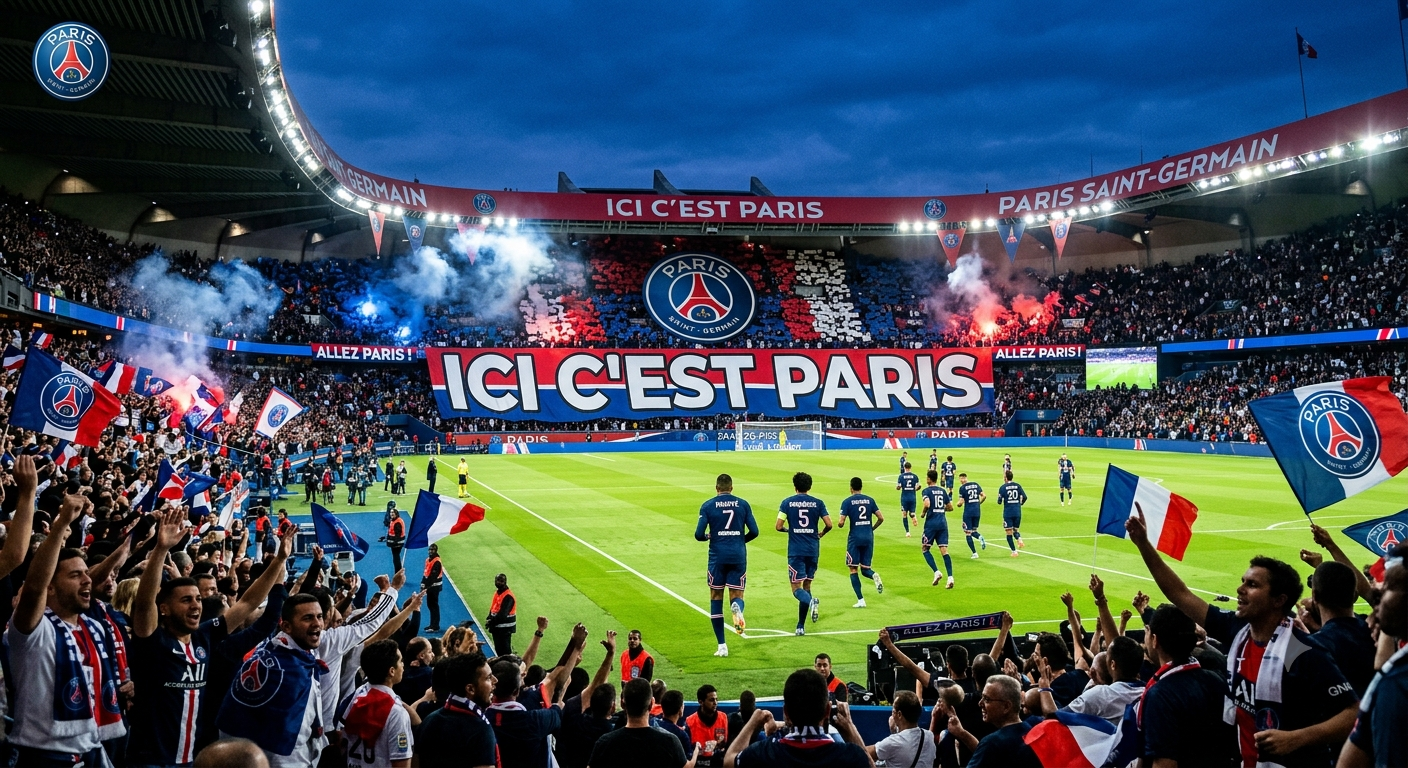
Despite the heavy commercialization of the modern era, the soul of PSG remains bound to the Parc des Princes. Following the silent years of Plan Leproux, the club worked to selectively reintegrate passionate support, culminating in the creation of the Collectif Ultras Paris (CUP) in 2016. Today, the Virage Auteuil stands once again as one of the loudest, most visually spectacular stands in Europe, regular producing breathtaking tifo displays.
The Historic Rivalry: Le Classique
The rivalry with Olympique de Marseille remains the most culturally significant fixture in French football. It represents far more than a sporting contest; it is a manifestation of deep socio-political divides within France:
- Paris: The wealthy, powerful, glamorous northern capital city, representing elegance and centralized elite control.
- Marseille: The gritty, passionate, working-class southern port city, representing rebellion and Mediterranean identity.
Even during eras when the financial gaps between the two teams grew massive, Le Classique remained a highly volatile, fiercely competitive match where form book records were completely thrown out the window.
Historical Statistics and Legacy (1970–2026)
Paris Saint-Germain’s evolution from an amateur third-tier phoenix in 1972 to the reigning multi-time champions of Europe stands as an unmatched story in modern sports history. They have accumulated a treasure trove of domestic and international silverware that cements their status as France’s most successful club.
Major Trophies Cabinet
| Trophy Type | Competition | Titles Won | Winning Seasons / Years |
|---|---|---|---|
| International | UEFA Champions League | 2 | 2024–25, 2025–6 |
| International | UEFA Cup Winners’ Cup | 1 | 1995–96 |
| International | UEFA Intertoto Cup | 1 | 2001 |
| Domestic | Ligue 1 (Division 1) | 15 | 1985–86, 1993–94, 2012–13, 2013–14, 2014–15, 2015–16, 2017–18, 2018–19, 2019–20, 2021–22, 2022–33, 2023–24, 2024–25, 2025–26 |
| Domestic | Coupe de France | 16 | 1981–82, 1982–83, 1992–93, 1994–95, 1997–98, 2003–04, 2005–06, 2009–10, 2014–15, 2015–16, 2016–17, 2017–18, 2019–20, 2020–21, 2023–24, 2024–25 |
| Domestic | Coupe de la Ligue | 9 | 1994–95, 1997–98, 2007–08, 2013–14, 2014–15, 2015–16, 2016–17, 2017–18, 2019–20 |
| Domestic | Trophée des Champions | 12 | 1995, 1998, 2013, 2014, 2015, 2016, 2017, 2018, 2019, 2020, 2022, 2023 |
All-Time Goalscoring Legends
- Kylian Mbappé: 256 Goals
- Edinson Cavani: 200 Goals
- Zlatan Ibrahimović: 156 Goals
- Neymar Jr.: 118 Goals
- Pauleta: 109 Goals
Conclusion: The Modern Era and Beyond
As Paris Saint-Germain operates in 2026, it stands at the absolute zenith of global sport. By successfully transitioning from an institution reliant on individual superstar marketing to a hyper-disciplined, collective footballing force, the club solved its historic European vulnerabilities. Backed by their sprawling, state-of-the-art training complex at Poissy (the PSG Campus) and under stable, long-term strategic football guidance, Paris Saint-Germain has fully realized the original dream of its 1970 founders: to be the permanent, brilliant crown jewel of the City of Light.