The Complete, Definitive History of Liverpool Football Club
To understand Liverpool Football Club is to understand more than just a sports institution. It is an exploration of industrial history, civic identity, collective grief, and unparalleled sporting triumph. Founded out of a landlords’ dispute in 1892, Liverpool FC grew from a local upstart into a global footballing juggernaut, capturing 19 English League Titles, 6 European Cups, and a permanent place in the fabric of popular culture.
This is the comprehensive story of the Reds—from the muddy fields of the Victorian era to the modern global empire of the 21st century.
1. The Genesis: A Landlord’s Dispute (1892–1959)
The story of Liverpool Football Club begins ironically with the history of its fiercest local rival: Everton FC. Founded in 1878, Everton had been playing their home matches at Anfield, a stadium owned by a wealthy local businessman and future Mayor of Liverpool, John Houlding.
As Everton’s popularity grew, Houlding raised the rent on the Anfield ground. The Everton board rebelled, opting to purchase a new plot of land across Stanley Park, which would become Goodison Park. Left with a magnificent, empty stadium but no team to play in it, Houlding took a bold step. On March 15, 1892, he officially formed Liverpool Football Club.
[Everton Leaves Anfield] ➔ [John Houlding Left with Empty Ground] ➔ [March 1892: Liverpool FC Formed]
The Team of Macaros
Liverpool’s first manager, John McKenna, recruited heavily from Scotland, constructing a squad heavily populated by Scottish players. They became affectionately known as the “Team of all the Macs.”
The club’s first application to join the Football League was rejected, forcing them to spend their inaugural 1892–93 season in the Lancashire League. They won the competition comfortably, earning election to the Football League Second Division for the following year.
Liverpool hit the ground running, earning promotion to the First Division immediately. Under the guidance of managers McKenna and Tom Watson, the club secured its first ever First Division League Championship in 1901. Watson replicated this success in 1906, anchoring Liverpool as a rising force in English football.
The Birth of the Spion Kop
In 1906, following their second league title, Anfield underwent a massive expansion. A large, banked terrace was constructed behind the goal at the Walton Breck Road end. Archibald Leitch, the legendary stadium architect, designed the structure.
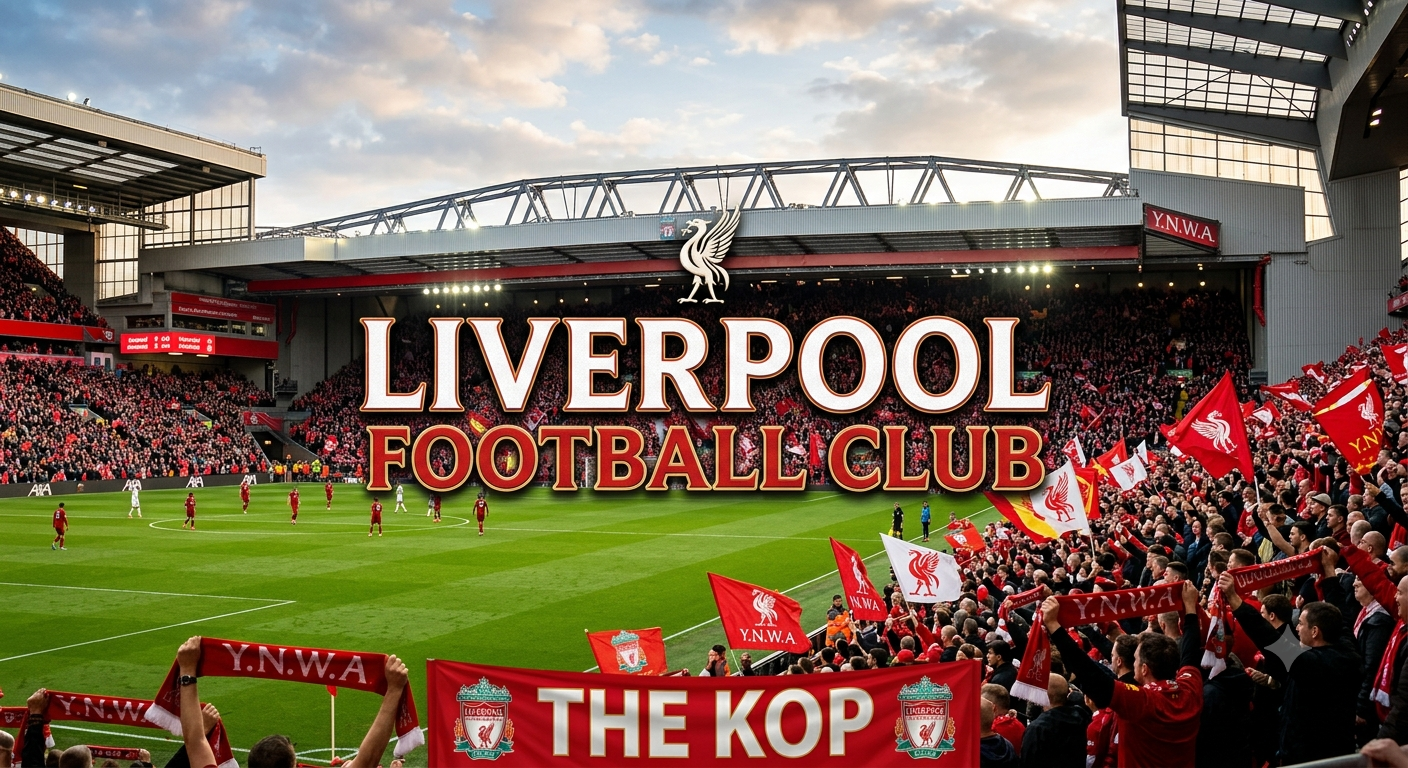
Ernest Edwards, the sports editor of the Liverpool Post, christened the massive terrace the Spion Kop. The name commemorated the Battle of Spion Kop in South Africa during the Boer War, where a local regiment—the Lancashire Fusiliers—suffered devastating casualties. The steep hill of the terrace visually mirrored the hill where the battle took place. The Kop would soon become the most famous stand in world football, known for its roaring, swaying wall of humanity.
Post-War Stagnation
Liverpool achieved back-to-back league titles in 1922 and 1923, featuring legendary figures like goalkeeper Elisha Scott. However, the club entered a long period of mediocrity through the 1930s.
Following World War II, Liverpool briefly tasted glory again by winning the first post-war League Championship in 1947. But the success was fleeting. A slow, agonizing decline culminated in relegation to the Second Division in 1954. For five long seasons, the club languished in football’s second tier, crippled by an antiquated training regimen, a crumbling stadium, and a board of directors unwilling to invest.
2. The Messiah: The Bill Shankly Revolution (1959–1974)
On December 1, 1959, a charismatic, sharp-tongued Scotsman named Bill Shankly walked through the doors of Anfield. His arrival would permanently alter the trajectory of the club.
The State of the Club
Shankly found a club in tatters. The Anfield pitch lacked an adequate watering system, the training ground at Melwood was an overgrown wilderness, and the squad was bloated with unmotivated players.
Shankly immediately went to work. He cleaned out the deadwood, demanded funds from the board, and transformed Melwood into a modern training facility. More importantly, he fostered an intense, symbiotic connection between the football team and the working-class people of Liverpool. As Shankly famously noted:
“The socialism I believe in is everybody working for the same goal and everybody having a share in the rewards. That’s how I see football, that’s how I see life.”
The Birth of the Boot Room
Shankly’s greatest structural masterstroke was the institutionalization of the Boot Room. Converting a small storage room where boots were cleaned, Shankly met daily with his coaching staff—Bob Paisley, Joe Fagan, Reuben Bennett, and later Tom Saunders.
Over tea and gin, these football minds debated tactics, analyzed opponents, and established a collective philosophy. The Boot Room became a university of football intelligence, ensuring continuity of culture and tactics for the next three decades.
Reaching the Summit
Shankly’s tactical updates yielded rapid rewards:
- 1962: Won the Second Division title, earning promotion back to the top tier.
- 1964: Won the First Division Championship. During this era, Shankly switched the club’s kit to all-red, reasoning that it would carry a psychological impact of power and intimidation.
- 1965: Won Liverpool’s first-ever FA Cup, defeating Leeds United 2–1 at Wembley.
- 1966: Claimed another League Championship and reached the European Cup Winners’ Cup final.
The Second Great Team
By the late 1960s, Shankly’s pioneering team had grown old. Showing no room for sentimentality, he ruthlessly dismantled his first great side and built a second generation of stars.
Out went heroes like Billy Liddell and Roger Hunt; in came youthful dynamic forces like Kevin Keegan, John Toshack, Ray Clemence, and Emlyn Hughes. This revamped squad recaptured the League Championship in 1973 and secured the club’s first continental silverware, the UEFA Cup, by defeating Borussia Mönchengladbach.
After winning the 1974 FA Cup in dominant fashion against Newcastle United, Shankly shocked the football world by announcing his retirement at the age of 60, citing exhaustion. He left behind a club systematically engineered for absolute dominance.
3. The Golden Era: Continental Dominance (1974–1985)
Fearing the vacuum left by Shankly’s departure, the Liverpool board looked directly to the Boot Room. They turned to Shankly’s quiet, unassuming assistant, Bob Paisley.
Bob Paisley: The Reluctant Genius
Paisley initially did not want the job, preferring his quiet role as a tactician and physio. Yet, his tenure became the most successful managerial run in English football history based on trophy-per-year ratios. While Shankly was the emotional architect who built the house, Paisley was the master craftsman who filled it with gold.
Paisley refined Liverpool’s style, shifting from a breathless, high-tempo British game to a patient, possession-heavy, European style of play. He made crucial signings, replacing a departing Kevin Keegan with Scottish forward Kenny Dalglish, who became arguably the greatest player to ever wear the red shirt. Alongside midfield engine Graeme Souness and lethal Welsh marksman Ian Rush, Dalglish formed the spine of an unstoppable machine.
PAISLEY'S TROPHY HAUL (1974-1983):
🏆 6x First Division Titles
🏆 3x European Cups
🏆 3x League Cups
🏆 1x UEFA Cup
Conquering Europe
Under Paisley, Liverpool turned the European Cup into their personal playground:
- 1977 (Rome): Liverpool won their first European Cup, defeating Borussia Mönchengladbach 3–1 in an emotional night in Italy.
- 1978 (Wembley): Retained the trophy with a 1–0 victory over Club Brugge, courtesy of a delicate Kenny Dalglish chip.
- 1981 (Paris): Defeated Real Madrid 1–0 via an unlikely strike from left-back Alan Kennedy.
When Paisley stepped down in 1983, he had won six League Championships and three European Cups in just nine years. The Boot Room continuity lived on as another disciple, Joe Fagan, took the reins. In his very first season (1983–84), Fagan guided Liverpool to an unprecedented Treble: the League Title, the League Cup, and the club’s fourth European Cup, famously defeating Roma on penalties in their own stadium.
4. Tragedy and Triumph (1985–1990)
The mid-to-late 1980s represent the most emotionally volatile era in Liverpool history—a period where sublime on-pitch beauty coexisted with devastating off-pitch horror.
The Heysel Stadium Disaster
On May 29, 1985, Liverpool reached their fifth European Cup final, facing Juventus at the Heysel Stadium in Brussels. The stadium was visibly dilapidated, and crowd tensions escalated before kickoff. A breach of a dividing fence by Liverpool fans caused a mass retreat of Juventus supporters against a concrete perimeter wall. The wall collapsed, killing 39 football fans, predominantly Italians, and injuring hundreds more.
The sporting fallout was immediate and severe. UEFA banned all English clubs from European competition indefinitely (a ban that ultimately lasted five years for most clubs, and six years for Liverpool). Joe Fagan retired immediately following the disaster, and the club turned to Kenny Dalglish as their first-ever player-manager.
Dalglish’s Double and the Flowing Football
Dalglish galvanized the club on the pitch. In his debut season as manager (1985–86), he scored the winning goal at Stamford Bridge to clinch the League Title, followed by an FA Cup final victory over Everton to secure the club’s first domestic Double.
By 1987, Dalglish constructed what many purists consider the most visually stunning team in Anfield history. Anchored by John Barnes, Peter Beardsley, Ray Houghton, and John Aldridge, this team tore opponents apart with fluid, one-touch passing football, cruising to the 1988 League Championship.
The Hillsborough Disaster
On April 15, 1989, Liverpool travelled to Hillsborough Stadium in Sheffield for an FA Cup semi-final against Nottingham Forest. Due to catastrophic mismanagement by South Yorkshire Police, thousands of fans were funneled into overcrowded, fenced pens behind the goal at the Leppings Lane end.
The resulting crush led to the tragic deaths of 97 Liverpool supporters. The disaster deeply traumatized the city. In the weeks that followed, Dalglish and his players attended dozens of funerals, providing comfort to a grieving community. The Sun newspaper published false accusations blaming Liverpool fans for the disaster, sparking a decades-long boycott of the publication across Merseyside.
Despite the profound emotional toll, Liverpool returned to the pitch to win the 1989 FA Cup in a poignant Merseyside final. The following year, in 1990, Dalglish guided the club to its 18th League Title. Nobody at the time could have predicted it would be their last for three decades.
5. The Premier League Wilderness (1990–2015)
The 1990s and early 2000s saw English football shift rapidly with the launch of the FA Premier League and massive television broadcasting deals. Liverpool, bogged down by institutional traditionalism, struggled to keep pace with an evolving landscape.
The Decline Under Souness and Evans
Exhausted by the emotional burden of the Hillsborough tragedy and its aftermath, Kenny Dalglish resigned in early 1991. The club appointed former captain Graeme Souness. Souness attempted to overhaul the aging squad too quickly, alienating key veterans and dismantling the traditional Boot Room structure. Under his watch, Liverpool fell away from the title picture as Manchester United rose to dominance under Alex Ferguson.
Roy Evans took over in 1994, restoring some of Liverpool’s signature attacking style. He integrated a talented crop of academy graduates including Robbie Fowler, Steve McManaman, and Jamie Redknapp. While this “Spice Boys” era produced thrilling football, it lacked the defensive resilience and discipline required to challenge for titles, winning only a solitary League Cup in 1995.
The Houllier Era and the 2001 Cup Treble
In 1998, Liverpool appointed their first foreign manager, Frenchman Gérard Houllier. Houllier modernized the club’s diet, sports science, and recruitment, while also bringing discipline back to the squad. He built the team around rock-solid defenders like Jamie Carragher and a generational midfield prodigy named Steven Gerrard.
The peak of Houllier’s tenure came in the 2000–01 season, when Liverpool won a unique treble of knockout cups:
- The League Cup (against Birmingham City)
- The FA Cup (a dramatic 2–1 comeback against Arsenal, courtesy of Michael Owen)
- The UEFA Cup (a chaotic 5–4 golden-goal victory over Deportivo Alavés)
Houllier suffered a major heart scare during a match in October 2001. Though he returned to the dugout, the team’s upward trajectory slowed, and he departed amicably in 2004.
The Miracle of Istanbul (2005)
Spanish tactician Rafael Benítez succeeded Houllier. In his debut season, Benítez masterminded one of the greatest fairy-tale campaigns in football history. Liverpool reached the 2005 UEFA Champions League Final in Istanbul, facing a star-studded AC Milan side.
At halftime, Liverpool were down 3–0, thoroughly outclassed. What followed remains etched in sporting folklore. Spurred on by a travelling support singing “You’ll Never Walk Alone,” Steven Gerrard scored a looping header to spark a historic fightback. Three goals in six minutes leveled the score at 3–3. Following miraculous extra-time saves by Jerzy Dudek, Liverpool won the ensuing penalty shootout, capturing their fifth European Cup.
Benítez built a formidable European outfit, reaching another Champions League final in 2007 and narrowly missing out on the Premier League title in 2009 with a team featuring the elite partnerships of Xabi Alonso, Javier Mascherano, and Fernando Torres.
Financial Turmoil and Near-Bankruptcy
In 2007, American businessmen Tom Hicks and George Gillett purchased the club. Their tenure was defined by leveraged debt, fractured boardroom relationships, and broken promises regarding a new stadium. By 2010, the club was on the verge of administration.
In October 2010, following a high-stakes High Court battle, the club was bought by Fenway Sports Group (FSG), led by John W. Henry. FSG stabilized the finances and appointed Brendan Rodgers in 2012. Rodgers brought an expansive attacking style that came agonizingly close to winning the Premier League in 2013–14. Powered by a lethal 31-goal season from Luis Suárez, Liverpool fell just short after a costly late-season slip against Chelsea.
6. The Resurrection: Jürgen Klopp and the Modern Era (2015–2024)
On October 8, 2015, Liverpool announced the appointment of former Borussia Dortmund manager Jürgen Klopp. Upon arrival, Klopp declared that he wanted to turn the club’s fanbase “from doubters to believers.” His charismatic leadership, combined with a high-intensity Gegenpressing (counter-pressing) philosophy, revived the club.
Building the Juggernaut
Working in tandem with sporting director Michael Edwards, FSG and Klopp utilized data-driven recruitment to assemble a world-class squad. Crucial additions included:
- 2016: Sadio Mané
- 2017: Mohamed Salah (who scored a record-breaking 32 goals in his debut Premier League campaign)
- 2018: Virgil van Dijk and Alisson Becker (providing the elite defensive backbone the team had lacked for decades)
Sixth European Crown
After suffering a heartbreaking defeat to Real Madrid in the 2018 Champions League final, Liverpool returned with a vengeance the following year. In the 2019 semi-finals, trailing 3–0 from the first leg against Barcelona, Klopp’s side pulled off a stunning 4–0 second-leg comeback at Anfield without key players. They went on to defeat Tottenham Hotspur 2–0 in Madrid to claim their sixth European Cup.
Ending the 30-Year Drought
The definitive crowning achievement of the Klopp era came during the 2019–20 season. Liverpool put together one of the most dominant campaigns in English football history, winning 26 of their first 27 matches.
Despite a three-month suspension of the season due to the global COVID-19 pandemic, Liverpool officially clinched the Premier League title in June 2020 with seven games to spare. It ended a painful 30-year wait, cementing Klopp’s legendary status alongside Shankly, Paisley, and Dalglish.
Klopp continued to bring silverware to Anfield, winning a domestic cup double (FA Cup and League Cup) in 2022 while narrowly missing out on an unprecedented quadruple. In early 2024, Klopp announced his departure from Anfield, leaving behind a structurally sound, world-class modern football club.
7. The New Horizon (2024–Present)
Following Klopp’s departure, Liverpool entered a new era under the leadership of Dutch manager Arne Slot, who transitioned the team toward a more controlled, possession-oriented style. Bolstered by a state-of-the-art training complex at Kirkby and an expanded 61,000-seat Anfield, Liverpool FC enters the modern landscape as a financial and sporting heavyweight, continually competing at the absolute pinnacle of global football.
8. Summary of Major Trophies
Over its long history, Liverpool has built one of the most decorated trophy cabinets in the history of world football:
| Competition | Titles Won | Winning Years |
| First Division / Premier League | 19 | 1901, 1906, 1922, 1923, 1947, 1964, 1966, 1973, 1976, 1977, 1979, 1980, 1982, 1983, 1984, 1986, 1988, 1990, 2020 |
| European Cup / UEFA Champions League | 6 | 1977, 1978, 1981, 1984, 2005, 2019 |
| FA Cup | 8 | 1965, 1974, 1986, 1989, 1992, 2001, 2006, 2022 |
| League Cup (EFL Cup) | 10 | 1981, 1982, 1983, 1984, 1995, 2001, 2003, 2012, 2022, 2024 |
| UEFA Cup / Europa League | 3 | 1973, 1976, 2001 |
| FIFA Club World Cup | 1 | 2019 |