Introduction: The Birth of Football Internazionale (1908–1922)
The foundation of Football Club Internazionale Milano, known globally as Inter Milan or simply Inter, is rooted in a fierce act of defiance and a beautiful philosophy of inclusion.
In early 1908, the Milan Cricket and Football Club (now known as AC Milan) dominated the local landscape. However, the Italian Football Federation and senior members of the club decided to ban foreign players from participating in national matches.
This narrow-minded directive infuriated a progressive group of Italian and Swiss dissidents within the club. Led by a visionary painter named Giorgio Muggiani, forty-four rebels broke away to form a new club on March 9, 1908, at the Orologio restaurant.
[1908: Founded by Dissidents] ──> [1910: First Scudetto Title] ──> [1928: Forced Name Change]
Muggiani designed the club’s iconic blue and black crest, choosing colors that stood directly opposite to AC Milan’s red. The name “Internazionale” was a deliberate declaration that the club would be a welcoming home to players of every nationality.
The club achieved success rapidly, capturing its first Scudetto (Italian league championship) in 1910 under the guidance of captain and coach Virgilio Fossati. Tragedy struck soon after when Fossati died serving in World War I, slowing the club’s momentum. Inter bounced back in 1920, winning their second league championship in a dramatic post-war season.
The Fascist Era and Ambrosiana Inter (1922–1945)
The rise of Benito Mussolini’s Fascist regime in the 1920s presented Inter Milan with its greatest existential challenge. The regime strongly disliked the name “Internazionale,” viewing it as highly unpatriotic and politically dangerous.
In 1928, the government forced the club to merge with another local side, Unione Sportiva Milanese. The historic name was erased, and the club was renamed Società Sportiva Ambrosiana, wearing a white jersey adorned with a large red cross—the symbol of Milan.
   ┌────────────────────────────────────────┐
   │     FASCIST REGIME INTERVENTION        │
   └───────────────────┬────────────────────┘
                       ▼
   ┌────────────────────────────────────────┐
   │ 1928: Forced Merge to Become Ambrosiana│
   └───────────────────┬────────────────────┘
                       ▼
   ┌────────────────────────────────────────┐
   │ Giuseppe Meazza Era (284 Club Goals)   │
   └────────────────────────────────────────┘
Despite having its identity suppressed, the club flourished on the pitch due to the emergence of arguably Italy’s greatest ever footballing icon: Giuseppe Meazza.
Nicknamed “Il Balilla”, Meazza debuted as a teenager and scored an astonishing 31 goals in Inter’s title-winning 1929–30 campaign—the inaugural season of the modern Serie A format.
Meazza’s sublime skill, clinical finishing, and charisma led the club to two more league crowns in 1938 and 1940, alongside its first Coppa Italia in 1939. Following the collapse of the fascist regime in 1945, the club quickly reclaimed its true name, becoming Internazionale once again.
Grande Inter: Herrera’s Golden Age (1955–1968)
In 1955, wealthy oil tycoon Angelo Moratti bought the club, determined to build a continental powerhouse. After a few rocky years of heavy spending with little return, he made a decision that changed football history: he hired Argentine mastermind Helenio Herrera in 1960.
Herrera revolutionized the sport by perfecting a tactical system known as Catenaccio (The Chain). It emphasized a rock-solid defensive line utilizing a “sweeper” behind three main defenders, hitting opponents with lightning-fast, vertical counter-attacks.
Herrera’s legendary squad became universally known as Grande Inter. The team featured an array of unforgettable football masters:
- Giacinto Facchetti: The pioneer of the modern, goal-scoring attacking fullback.
- Armando Picchi: The definitive sweeper and vocal captain.
- Luis Suárez: The brilliant Spanish deep-lying playmaker who pulled the strings.
- Sandro Mazzola: The creative, lightning-quick inside-forward.
       THE CONTINENTAL DOUBLE-DOUBLE
┌──────┬──────────────────────────────┬────────┐
│ Year │ Tournament                   │ Result │
├──────┼──────────────────────────────┼────────┤
│ 1964 │ European Cup Final vs Real   │  3–1   │
│ 1964 │ Intercontinental Cup         │ Winner │
│ 1965 │ European Cup Final vs Benfica│  1–0   │
│ 1965 │ Intercontinental Cup         │ Winner │
└──────┴──────────────────────────────┴────────┘
Grande Inter completely dominated Europe. In 1964, they dismantled Real Madrid 3–1 in Vienna to claim their first European Cup. They defended their crown in 1965, beating Eusebio’s Benfica 1–0 on a waterlogged San Siro pitch.
By adding back-to-back Intercontinental Cups to their three Serie A titles in the 1960s, Herrera’s Inter established themselves as one of the most tactically influential teams to ever play the game.
Steady Consistency and the German Trio (1968–1995)
Following the departure of the Moratti-Herrera vanguard, Inter maintained a steady presence at the top of Italian football. They won the Scudetto in 1971 under Giovanni Invernizzi and again in 1980 under Eugenio Bersellini.
The late 1980s brought a spectacular revival driven by manager Giovanni Trapattoni. To counter the dominant AC Milan side of Arrigo Sacchi, Inter signed an elite trio of West German superstars: midfield engine Lothar Matthäus, clinical striker Jürgen Klinsmann, and reliable left-back Andreas Brehme.
[1989: Record-Breaking Scudetto] ──> [1991, 1994, 1998: Three UEFA Cups]
The investment paid immediate dividends. In the 1988–89 season, Inter won a historic, record-breaking Scudetto, amassing 58 out of a possible 68 points (in the 2-points-for-a-win era), a feat often referred to as the Scudetto dei Record.
While domestic league success eluded them during the early 1990s, Inter transformed into a formidable knockout tournament team, winning three UEFA Cups in 1991, 1994, and 1998, establishing a fierce reputation across European competitions.
The Moratti Return and the Incomparable Il Fenomeno (1995–2004)
In 1995, history came full circle when Massimo Moratti, son of Angelo, purchased the club. Driven by his father’s passion, Moratti spent massive sums of money to bring the world’s most exciting talent to the San Siro.
His crowning achievement came in the summer of 1997, when he shattered the world transfer record to sign Brazilian icon Ronaldo, known simply as “Il Fenomeno”.
Ronaldo’s debut season was pure magic; he scored 34 goals in all competitions and put on a masterful display in the 1998 UEFA Cup final against Lazio, cementing his status as the best player on earth.
       MORATTI'S HIGH-PROFILE SIGNINGS
┌────────────────────────────────────────────────────────┐
│ • Ronaldo Nazário (World Record Fee from Barcelona)   │
│ • Christian Vieri (World Record Fee from Lazio)        │
│ • Javier Zanetti (First signing, went on to make 858 apps)│
└────────────────────────────────────────────────────────┘
Despite boasting an incredible attack that featured Ronaldo and Italian powerhouse Christian Vieri, Inter suffered from constant managerial turnover and bitter heartbreaks. The most agonizing moment occurred on May 5, 2002, when Inter lost 4–2 to Lazio on the final day of the season, throwing away a guaranteed Scudetto and leaving a substituted Ronaldo crying on the bench. It took structural changes to finally stabilize the club.
Domination and the Historic Treble (2004–2010)
The appointment of Roberto Mancini in 2004 brought long-awaited stability. Mancini built a highly disciplined squad that won the Coppa Italia in 2005. Following the Calciopoli referee-falsification scandal of 2006, which saw Juventus relegated, Inter emerged as the undisputed powerhouse of Italian football.
Mancini led Inter to three consecutive Serie A titles, including a breathtaking 2006–07 campaign where the Nerazzurri set an all-time league record with 17 consecutive victories. However, Massimo Moratti remained unsatisfied with domestic success; he wanted Europe.
The Special One: José Mourinho (2008–2010)
In 2008, Moratti hired Portuguese tactician José Mourinho. Mourinho infused the team with a relentless, fierce mental edge. After securing the league title in his first year, Mourinho fine-tuned the roster for the historic 2009–10 season, replacing Zlatan Ibrahimović with Samuel Eto’o, and adding playmaker Wesley Sneijder, striker Diego Milito, and center-back Lúcio.
   THE TRIPLE CROWN (2009–10)
[Coppa Italia] ──> [Serie A Title] ──> [Champions League Final (2–0)]
What followed remains the greatest single season in Italian football history. Inter fought off a fierce challenge from Roma to secure the Coppa Italia and the Serie A title. Then, on May 22, 2010, Inter met Bayern Munich in the UEFA Champions League Final at the Santiago Bernabéu.
With two clinical goals from Diego Milito, Inter won 2–0, completing the historic Treble (Serie A, Coppa Italia, and Champions League). Inter Milan remains the only Italian club in history to achieve this spectacular feat.
Transition, Foreign Ownership, and Contemporary Renaissance (2010–2026)
Following the Treble, the aging squad declined, leading to a difficult decade of transition. In 2013, Massimo Moratti sold the club to Indonesian tycoon Erik Thohir, ending the iconic Moratti era. In 2016, Chinese retail giant Suning Holdings Group, led by young president Steven Zhang, bought a majority stake, injecting vital financial resources back into the club.
<Image src="image_agent_tag_272314740467472329" alt="Inter Milan players celebrating on podium lifting Scudetto trophy surrounded by confetti" caption="Inter Milan celebrating their historic Scudetto triumph" />
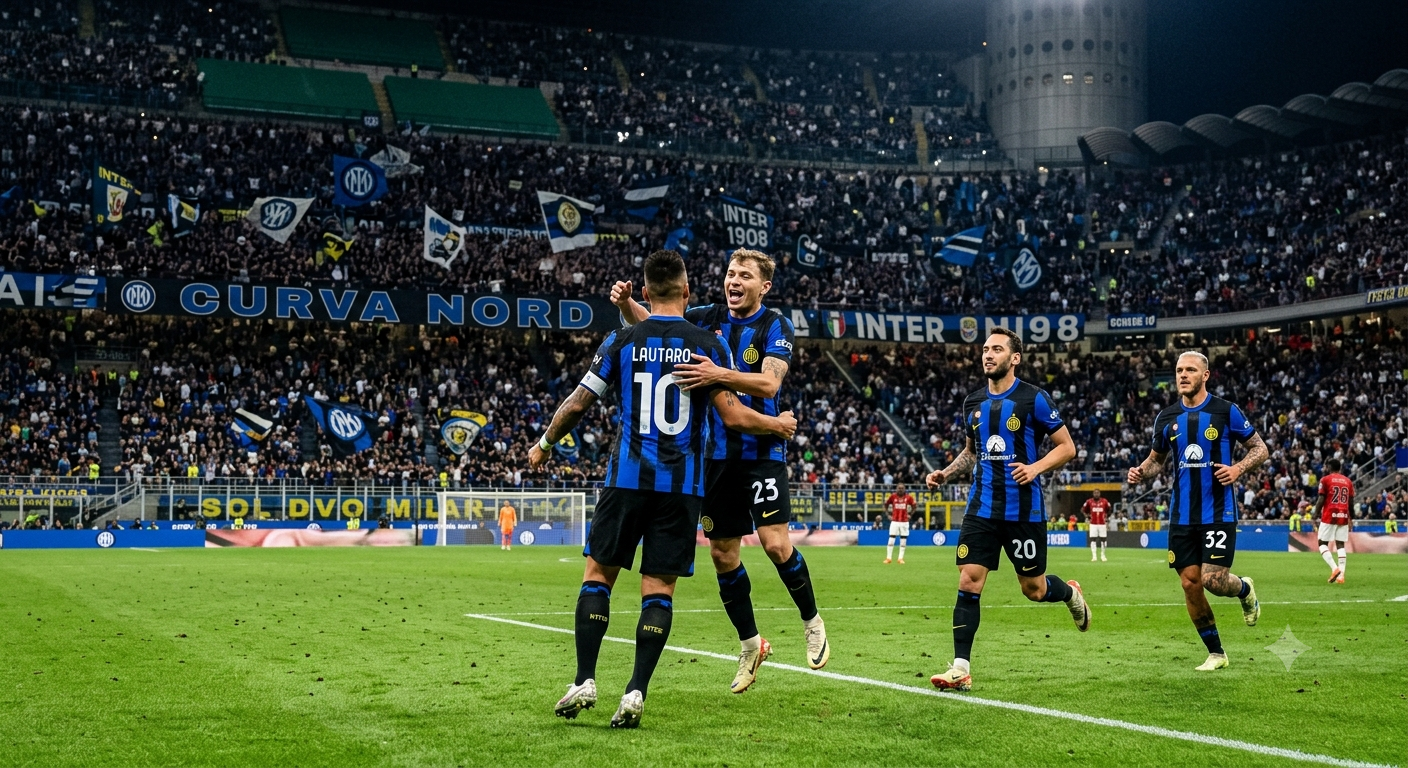
The sporting turnaround began with the arrival of manager Antonio Conte in 2019. Driven by the goals of Romelu Lukaku and the leadership of midfield star Nicolò Barella, Inter broke Juventus’s nine-year stranglehold on Italian football by capturing the 2020–21 Scudetto.
Simone Inzaghi and the Second Star
Following Conte’s departure, Simone Inzaghi took the helm in 2021. Inzaghi turned Inter into one of Europe’s most attractive, tactically flexible attacking sides, utilizing a dynamic 3-5-2 system.
Under his guidance, Inter reached the 2023 UEFA Champions League Final, narrowly losing 1–0 to Manchester City. Far from being discouraged, the team dominated the 2023–24 Serie A season. Led by captain Lautaro Martínez, Inter stormed to their 20th Scudetto title, earning the right to wear the coveted Second Star permanently on their jerseys.
In May 2024, American investment firm Oaktree Capital Management assumed ownership of the club, ushering in a highly stable, corporate-backed era focused on financial sustainability while keeping Inter competitive at the highest levels of European football.
Comprehensive Statistics & All-Time Honors
Inter Milan’s storied history is backed by an elite collection of domestic and international honors. Crucially, Inter holds the proud title of being the only Italian club never to be relegated from the top flight of Italian football since its inception.
- Serie A (Scudetto): 20
- Coppa Italia: 9
- Supercoppa Italiana: 8
- UEFA Champions League / European Cup: 3
- UEFA Cup: 3
- FIFA Club World Cup / Intercontinental Cup: 3
Frequently Asked Questions (FAQs)
Why is Inter Milan called ‘Nerazzurri’?
The nickname Nerazzurri translates directly to “Black and Blues” in Italian. It refers to the club’s traditional home jersey stripes, which were chosen in 1908 by founder Giorgio Muggiani to represent the night sky.
What is the significance of the “Second Star” on Inter’s shirt?
In Italian football, a club is awarded a permanent gold star on its jersey for every 10 Serie A titles won. By winning the Scudetto championship, Inter captured its 20th league title, allowing them to wear two stars on their crest.
Why do Inter Milan and AC Milan share the same stadium?
Both clubs share the historic Stadio Giuseppe Meazza, commonly known as San Siro. The stadium was built by AC Milan’s president in 1926, but Inter began sharing it in 1947 due to the financial practicality of maintaining a world-class arena together. When Inter plays at home, the stadium is traditionally referred to as the Giuseppe Meazza (honoring the Inter icon), whereas AC Milan fans prefer to call it San Siro.
What is the “Derby della Madonnina”?
The Derby della Madonnina is the historic local rivalry match between Inter Milan and AC Milan. It is named in honor of the statue of the Virgin Mary (the Madonnina) that sits atop Milan’s famous Duomo Cathedral.