MANCHESTER UNITED FOOTBALL CLUB: THE DEFINITIVE CHRONICLE
SECTION I: THE INDUSTRIAL FOUNDATIONS AND FINANCIAL TRANSFORMATION (1878–1945)
The Railway Men of Newton Heath
In the final quarter of the nineteenth century, Manchester was the undisputed heart of the global textile industry and a boiling pot of the British Industrial Revolution. The expansion of the railway infrastructure was vital to moving goods and coal. In 1878, the workers of the Carriage and Wagon department of the Lancashire and Yorkshire Railway (LYR) depot at Newton Heath sought a recreational outlet to balance their brutal, soot-filled working hours.
Led by their founders, the workmen established Newton Heath LYR Football Club.
[Lancashire & Yorkshire Railway Depot]
       │
       ▼ (1878)
[Newton Heath LYR FC] ──► (1892: Independent of Railway)
       │
       ▼ (1902: Near Bankruptcy)
[Manchester United FC] (Saved by J.H. Davies)
Initially, the club played on a deeply flawed, uneven pitch at North Road, located adjacent to the railway lines. The ground was infamous for being shrouded in thick industrial smog and coated in a layer of coal dust. The players wore the corporate colors of the LYR company: green and gold jerseys.
Despite their humble corporate origins, the team’s competitive nature drove them forward. In 1886, they entered the FA Cup for the first time. By 1892, the club severed its official corporate ties with the railway company, dropping the “LYR” suffix from their name and joining the Football League First Division.
However, independence brought acute financial instability. The club relocated to a new ground at Bank Street in Clayton, but the pitch was barely playable, often described by visiting teams as a marshland bordered by chemical factories. By 1902, the club was buried under debts exceeding £2,500—an astronomical sum for a working-class sports club at the time. A winding-up order was issued, and the club stood on the absolute brink of extinction.
The St. Bernard and the Brewery: The Birth of United
The salvation of the club is one of the most famous pieces of folklore in British sports history. The club’s captain, Harry Stafford, owned a prized St. Bernard dog named Major. In an effort to raise funds, Stafford placed a collection box on the dog and let him wander through a fundraising bazaar. Major slipped away and wandered into the path of John Henry Davies, a wealthy local brewery tycoon.
Davies tracked the dog back to Stafford. Captivated by Stafford’s fierce dedication to the dying club, Davies decided to intervene. Alongside three other local businessmen, each investing £200, Davies cleared the club’s debilitating debts and took control.
With a clean financial slate came the necessity for a total structural and cultural rebranding. On April 24, 1902, the board met to permanently alter the club’s name. After rejecting names like Manchester Celtic and Manchester Central, they settled on a moniker that would echo through history: Manchester United Football Club. The green and gold shirts were discarded, replaced by red jerseys, white shorts, and black socks.
The Mangnall Era and the Construction of Old Trafford
Davies brought corporate ambition to the newly christened club. In 1903, he hired Ernest Mangnall as manager. Mangnall was a brilliant tactician and an astute psychological motivator. He transformed United’s fitness regimes and orchestrated the controversial signing of superstar winger Billy Meredith from local rivals Manchester City.
The investments bore immediate fruit. United won their first ever Football League First Division title in 1908. To cement their arrival as an elite force, Mangnall’s side captured the FA Cup in 1909, defeating Bristol City 1–0, followed by a second league title in 1911.
       [ERNEST MANGNALL ERA]
 ┌───────────────────────┴───────────────────────┐
 ▼                                               ▼
1908 First Division Title                       1910 Move to Old Trafford
1909 FA Cup Trophy                              1911 Second First Division Title
Davies realized that the dilapidated Bank Street ground could no longer contain the club’s soaring ambitions. He personally financed the purchase of land in Old Trafford, an industrial area southwest of the city center. He hired the legendary Scottish architect Archibald Leitch to design a world-class sporting arena.
Opened on February 19, 1910, Old Trafford was hailed as the finest stadium in the British Empire, boasting a capacity of 80,000 spectators. However, the initial euphoria was short-lived. In 1912, Mangnall stunned the fanbase by departing to manage Manchester City.
The Interwar Stagnation and the Blitz
The decades between World War I and World War II were the darkest in the club’s history. Deprived of Mangnall’s leadership and facing the economic devastation of the Great Depression, Manchester United turned into a “yo-yo club,” constantly bouncing between the First and Second Divisions. Financial ruin knocked at the door once more in 1931. The club was saved by another white-knight investor, James W. Gibson, who injected cash to pay the players’ wages and restructure the academy system.
Then came World War II. Competitive football was suspended, and Old Trafford was requisitioned by the military. On the night of March 11, 1941, during the height of the Manchester Blitz, German Luftwaffe bombers targeted the industrial complexes of the nearby Trafford Park. Several bombs struck Old Trafford, completely destroying the main stand, burning the pitch, and reducing the club’s offices to rubble. Left without a home, United were forced to play their post-war fixtures at Manchester City’s Maine Road, paying their rivals a rental fee. The club was homeless, broke, and fractured.
SECTION II: THE BUSBY BABES, THE MUNICH TRAGEDY, AND EUROPEAN TRIUMPH (1945–1969)
The Matt Busby Revolution
In the autumn of 1945, amidst the ruins of post-war Britain, James Gibson made the most consequential decision in the history of the club. He offered the managerial post to Matt Busby, a former Liverpool and Manchester City half-back. Busby accepted, but on one radical condition: he demanded absolute, unprecedented control over team selection, training methodologies, player transfers, and youth development. In an era where club directors traditionally dictated team affairs, Busby’s demands were revolutionary.
Busby brought in his trusted lieutenant, Jimmy Murphy, a fiery, deeply passionate Welshman who possessed an extraordinary eye for young talent. Together, they formed the greatest management partnership of the post-war era.
Rather than entering the transfer market to buy expensive, established players, Busby and Murphy decided to build an empire from the ground up. They established a highly sophisticated scouting network across the British Isles, hunting for schoolboys with elite potential.
The Rise of the Busby Babes
By the early 1950s, the fruits of this youth policy emerged. The team that captured the First Division championship in 1956 and 1957 swept the country off its feet. Dubbed the “Busby Babes” by the media, the squad had an astonishingly young average age of 22. They played a brand of football that was completely alien to the rigid, physical, long-ball style typical of English football at the time. They were fluid, expressive, fast, and technically brilliant.
At the heart of this side was Duncan Edwards. Standing over six feet tall, built like a powerhouse, yet possessing the delicate touch of a playmaker, Edwards was widely considered the greatest young talent in the world. Alongside him were prolific goalscorers like Tommy Taylor and Dennis Viollet, alongside defensive anchors like Mark Jones and a young, incredibly gifted winger named Bobby Charlton.
                  [THE BUSBY BABES]
  ┌───────────────────────┼───────────────────────┐
  ▼                       ▼                       ▼
Duncan Edwards          Tommy Taylor            Bobby Charlton
(Powerhouse Midfielder) (Prolific Goalscorer)   (Generational Winger/Forward)
Busby’s ambitions extended far beyond the borders of England. In 1956, against the explicit, draconian directives of the Football League and its rigid secretary Alan Hardaker, Busby entered Manchester United into the European Cup (now the UEFA Champions League). Busby recognized that the future of football lay in continental competition, matching wits against heavyweights like Real Madrid and Milan.
The Munich Air Disaster
The fairytale was brutally shattered on February 6, 1958. The team was returning from Belgrade after securing a 3–3 draw against Red Star Belgrade to advance to the European Cup semi-finals. Their charter plane, a British European Airways Airspeed Ambassador, stopped at a slush-covered Munich-Riem Airport in Germany to refuel.
After two aborted takeoff attempts due to engine boost surges, the pilot made a third attempt. As the aircraft accelerated down the runway, it hit a treacherous patch of slush at the end of the strip. The plane lost critical speed, plowed through a perimeter fence, tore its left wing off against a nearby house, and struck a wooden garage filled with fuel, causing an immediate explosion.
[Munich Air Disaster - February 6, 1958]
  ├── 23 Total Fatalities
  ├── 8 Manchester United Players Lost
  │     ├── Geoff Bent, Roger Byrne, Eddie Colman, Mark Jones,
  │     └── David Pegg, Tommy Taylor, Liam Whelan, Duncan Edwards (died 15 days later)
  └── 3 Club Staff Members Lost
The disaster devastated the club. Seven players died instantly. Duncan Edwards survived the initial impact but succumbed to severe kidney damage 15 days later in a Munich hospital. Matt Busby was read his last rites twice but miraculously survived after months in an oxygen tent.
Out of the Ashes
With Busby incapacitated, the monumental task of keeping Manchester United alive fell entirely upon assistant manager Jimmy Murphy. Murphy, who had missed the fateful trip because he was managing the Welsh national team in a World Cup qualifier, displayed legendary fortitude.
He patched together a makeshift squad composed of reserves, youth players, and emergency signings. Just 13 days after the crash, this emotional, heavily scarred side defeated Sheffield Wednesday 3–0 in an FA Cup tie at Old Trafford, a match where the program printed a blank space where the names of the players should have been. Incredibly, Murphy guided this shattered club to the 1958 FA Cup Final at Wembley, an achievement born of pure, unadulterated human will.
The Holy Trinity and European Glory
By the early 1960s, a recovered Matt Busby returned to dugout duties. He set about constructing a second great team, combining the traumatic lessons of the past with aggressive transfer market moves. He retained Munich survivors Bobby Charlton and Bill Foulkes as the spiritual spine of the team. In 1962, he broke the British transfer record to sign the fierce Scottish forward Denis Law from Torino. Then, in 1963, Busby uncovered a lean, long-haired teenager from Belfast: George Best.
Best was a footballing genius—an unstoppable dribbler who could leave world-class defenders dead in their tracks. Together, Charlton, Law, and Best became known as the “Holy Trinity” (or the United Trinity). They propelled Manchester United to domestic league titles in 1965 and 1967.
               [THE HOLY TRINITY]
  ┌────────────────────┼────────────────────┐
  ▼                    ▼                    ▼
Bobby Charlton      Denis Law          George Best
(The Engine)        (The Finisher)     (The Magician)
The ultimate culmination of Busby’s life work arrived on May 29, 1968. Ten years after the horrors of Munich, Manchester United walked out onto the Wembley pitch to face Benfica in the European Cup Final.
The match was an epic, emotionally exhausting encounter. Tied 1–1 at the end of normal time, United unleashed a devastating attacking blitz in extra time. George Best scored a dazzling solo goal, followed by strikes from Brian Kidd and a second from Bobby Charlton. United ran out 4–1 victors.
When the final whistle blew, Busby and Charlton embraced on the pitch, weeping openly for the friends they had lost in the snows of Munich. Manchester United was the first English club to lift the European Cup, completing a legendary resurrection.
SECTION III: THE WILDERNESS YEARS AND THE STRUGGLE FOR IDENTITY (1969–1986)
The Post-Busby Hangover
Following his European triumph, Matt Busby was knighted. In 1969, he stepped down as manager, moving upstairs to join the board of directors. His departure plunged the club into a massive institutional hangover that lasted nearly two decades. The club failed to prepare for the inevitable decline of the Holy Trinity.
Busby’s hand-picked successor, Wilf McGuinness, struggled under the immense, suffocating shadow of his former boss. The senior players, accustomed to Busby’s authority, routinely undermined the young manager. McGuinness was sacked in late 1970, forcing Busby to temporarily return to the dugout to steady a sinking ship.
The appointment of Frank O’Farrell in 1971 brought brief hope, but George Best’s personal battles with alcoholism were spiraling out of control. Best began missing training sessions and skipping matches. Without Best’s magic, Denis Law’s aging knees, and Bobby Charlton’s impending retirement, United plummeted down the table. O’Farrell was dismissed in late 1972 after a humiliating 5–0 defeat to Crystal Palace.
Relegation and the Docherty Era
The charismatic, fast-talking Scotsman Tommy Docherty (nicknamed “The Doc”) was brought in to save the club from relegation. While he kept them up in 1973, the inevitable collapse occurred the following season. The 1973–74 campaign was an unmitigated disaster. The final nail in the coffin was struck with poetic cruelty on April 27, 1974.
United faced arch-rivals Manchester City at Old Trafford, needing a victory to have any hope of survival. In the closing minutes of the game, Denis Law, who had been released by United on a free transfer, scored a backheel goal for City. Law refused to celebrate, walking off the pitch with his head bowed, visibly devastated. United lost 1–0 and were officially relegated to the Second Division for the first time since 1938.
“I felt depressed. How long did the feeling last? How long ago was it? I’m still depressed.” — Denis Law, reflecting on his relegation-sealing goal against Manchester United.
Rather than firing Docherty, the board retained him, a decision that paid off handsomely. Docherty cleared out the remaining deadwood and built a thrilling, high-tempo team focused on lightning-fast wing play, featuring players like Steve Coppell, Gordon Hill, and Sammy McIlroy.
United won the Second Division at the first attempt, returning to the top flight in 1975. Docherty guided them to consecutive FA Cup finals, losing shockingly to Southampton in 1976, but redeeming themselves in 1997 by defeating Bob Paisley’s highly favored Liverpool 2–1, explicitly denying their rivals a treble. However, just weeks after this historic cup triumph, Docherty was controversially sacked after it was revealed he was having an extramarital affair with Mary Brown, the wife of the club’s physiotherapist.
The Stagnation of the Late ’70s and early ’80s
Dave Sexton replaced Docherty, bringing a highly disciplined, tactical, but ultimately dull style of football that failed to capture the imagination of the Old Trafford faithful. Although he took the club to the classic 1979 FA Cup Final—losing 3–2 to Arsenal in a frantic finish—his lack of silverware led to his dismissal in 1981.
Enter Ron Atkinson. Known as “Big Ron,” Atkinson was a flamboyant manager who wore heavy gold jewelry, drove expensive sports cars, and brought showbiz glamour back to Old Trafford. In 1981, he broke the British transfer record to sign midfield powerhouse Bryan Robson from West Bromwich Albion for £1.5 million. Robson, nicknamed “Captain Marvel,” became the defining United player of the 1980s—a box-to-box warrior who carried the team on his back through sheer force of will.
                  [THE RON ATKINSON ERA]
  ┌─────────────────────────┴─────────────────────────┐
  ▼                                                   ▼
Bryan Robson Signed (£1.5M)                        Two FA Cup Trophies (1983, 1985)
Atkinson’s teams were highly entertaining, winning the FA Cup in 1983 and 1985. The 1985–86 season started with an explosive run of ten consecutive league victories, and it appeared the long wait for a league title was finally ending. However, the squad lacked tactical discipline and depth; the form collapsed after Christmas, and United finished a distant fourth.
By the autumn of 1986, with the team hovering precariously close to the relegation zone and drinking culture rampant throughout the dressing room, the board decided that Atkinson’s time was up. The club needed a disciplinarian to save them.
SECTION IV: THE ALEX FERGUSON DYNASTY (1986–2013)
The Arrival of the Grim Scot
On November 6, 1986, Manchester United appointed Alex Ferguson, the fierce Scottish manager who had broken the historic Celtic-Rangers duopoly in Scotland with Aberdeen, even defeating Real Madrid to win the 1983 European Cup Winners’ Cup. Ferguson arrived at Old Trafford horrified by what he discovered. The squad was physically unfit, severely lacking in tactical discipline, and thoroughly dominated by a toxic drinking culture led by senior stars.
Ferguson immediately cracked down on the squad’s lifestyle, demanding total professionalism. His early years, however, were an uphill battle. The team finished 11th in his first season. Despite a second-place finish in 1988, the 1988–89 campaign saw them slip back to 11th. By December 1989, fans had run out of patience. A famous banner was unveiled at Old Trafford: “Three years of excuses and it’s still crap… Ta-ra Fergie.”
[December 1989: Fan Discontent] ──► "Ta-ra Fergie" Banner
               │
               ▼ (January 1990)
[Mark Robins Goal vs Nottingham Forest] ──► Turning Point of Club History
               │
               ▼ (May 1990)
[FA Cup Triumph] ──► First Trophy under Ferguson
The absolute turning point of modern Manchester United history arrived on January 7, 1990. United faced a daunting FA Cup Third Round tie away at Nottingham Forest. Rumors circulated widely in the press that a defeat would seal Ferguson’s dismissal. In a tense game, a young striker named Mark Robins headed home a cross from Mark Hughes to secure a 1–0 win.
This narrow victory sparked an FA Cup run that culminated in a grueling 3–3 draw and a subsequent 1–0 replay victory over Crystal Palace in the Final. Ferguson had won his first trophy, securing his job and buying the time he needed to fundamentally rebuild the club.
The Catalyst: Eric Cantona and the Dawn of the Premier League
In 1991, Ferguson guided United to the European Cup Winners’ Cup, defeating Barcelona 2–1 in Rotterdam. Yet, the domestic league title remained out of reach. In the inaugural 1992–93 season of the newly rebranded English Premier League, United found themselves desperately lacking a creative spark up front.
In November 1992, Ferguson made a phone call to Leeds United managing director Bill Fotherby to inquire about defender Lee Chapman. During the conversation, Leeds mentioned that their temperamental French forward, Eric Cantona, was available. Ferguson moved instantly, signing Cantona for a modest £1.2 million.
It was the most impactful signing in Premier League history. Cantona was a catalyst—an arrogant, brilliantly gifted maverick who walked with his collar turned up and possessed an aura of complete authority. He unlocked opposition defenses, galvanized the squad, and instilled a deep sense of swagger in the club. Led by Cantona, Manchester United won the 1992–93 Premier League title, ending their agonizing 26-year league drought.
                  [THE CANTONA CATALYST]
  ┌─────────────────────────┴─────────────────────────┐
  ▼                                                   ▼
1992-93: First League Title in 26 Years             1993-94: First League & FA Cup Double
The following year, 1993–94, Ferguson’s first truly great side secured the club’s first-ever League and FA Cup Double. This was a ferocious team, boasting a rock-solid defense of Peter Schmeichel, Gary Pallister, and Steve Bruce, a relentless midfield engine room of Roy Keane and Paul Ince, and the attacking genius of Cantona, Mark Hughes, and Andrei Kanchelskis.
You Can’t Win Anything with Kids: The Class of ’92
The 1994–95 season ended in heartbreak. United lost the league title on the final day to Blackburn Rovers and fell to Everton in the FA Cup Final. Worse, Eric Cantona had been hit with an eight-month global ban after launching a kung-fu kick at a Crystal Palace fan who had racially abused him at Selhurst Park.
In the summer of 1995, Ferguson made a move that left football pundits and fans stunned. He sold three core senior stars: Paul Ince, Mark Hughes, and Andrei Kanchelskis. He bought absolutely no replacements. Instead, he promoted a group of young academy graduates who had won the 1992 FA Youth Cup. This group, forever known as the “Class of ’92,” included Ryan Giggs, David Beckham, Paul Scholes, Gary Neville, Phil Neville, and Nicky Butt.
                         [THE CLASS OF '92]
  ┌───────────────┬───────────────┼───────────────┬───────────────┐
  ▼               ▼               ▼               ▼               ▼
Ryan Giggs  David Beckham   Paul Scholes    Gary Neville    Phil Neville
On the opening day of the 1995–96 season, this youthful United side suffered a resounding 3–1 defeat away at Aston Villa. That evening on BBC’s Match of the Day, prominent television pundit Alan Hansen delivered a definitive verdict that would live in infamy: “You can’t win anything with kids.”
Ferguson’s kids proved him spectacularly wrong. As the season progressed, the youngsters grew into an elite force. Fueled by the return of Eric Cantona in October, United overhauled a massive 12-point deficit to catch Kevin Keegan’s Newcastle United. They secured the Premier League title and defeated Liverpool 1–0 in the FA Cup Final courtesy of a late Cantona volley, completing a historic second Double. When Cantona shocked the football world by retiring abruptly in 1997 at the age of 30, the Class of ’92 stepped forward to inherit absolute leadership of the club.
The Holy Grail: The 1999 Treble
The absolute zenith of the Sir Alex Ferguson era, and arguably the greatest single achievement in English football history, arrived during the 1998–99 season. Refusing to rest on his laurels, Ferguson spent heavily to sign Dutch defender Jaap Stam, Trinidadian striker Dwight Yorke, and winger Jesper Blomqvist. Yorke formed an almost telepathic striking partnership with Andy Cole, supported by the veteran alternative pairing of Teddy Sheringham and Ole Gunnar Solskjær.
United fought an exhausting, brutal three-front campaign.
- The Premier League: Secured on the final day of the season with a tense 2–1 comeback victory over Tottenham Hotspur at Old Trafford.
- The FA Cup: Achieved after a grueling campaign, featuring a historic, legendary semi-final replay against Arsenal where Ryan Giggs scored a breathtaking solo goal in extra time after weaving through the entire Gunners defense. United beat Newcastle 2–0 in the Final at Wembley.
The final piece of the puzzle was the UEFA Champions League. On May 26, 1999, United faced German giants Bayern Munich at the Camp Nou in Barcelona. Deprived of their inspirational captain Roy Keane and midfield controller Paul Scholes due to suspensions, United struggled significantly. Mario Basler scored a free-kick in the sixth minute to put Bayern 1–0 ahead. For the remaining 84 minutes, Bayern dominated the match, striking the post and the crossbar.
As the fourth official indicated three minutes of injury time, the European Cup looked destined for Munich. Then, chaos erupted.
[90:36] United Corner ──► Beckham crosses ──► Giggs mis-hits volley ──► Sheringham stabs home (1-1)
[92:17] Another Corner ──► Beckham crosses ──► Sheringham heads down ──► Solskjær pokes into roof (2-1)
In less than two minutes of pure sporting drama, United turned the game on its head. When the final whistle blew, the Bayern players collapsed to the turf in complete disbelief. Alex Ferguson walked into his post-match interview and uttered three words that defined the campaign: “Football, bloody hell.” Following this achievement, Ferguson was officially knighted by Queen Elizabeth II.
The Rebuilding, The Glazer Takeover, and the European Peak (2003–2009)
The early 2000s saw United remain dominant domestically, winning titles in 2000, 2001, and 2003, but the squad was in transition. Landmark signings like Ruud van Nistelrooy arrived and scored goals at an astonishing rate, but the departures of David Beckham and Jaap Stam signaled a changing of the guard.
In 2003, Ferguson signed a flamboyant, extraordinarily fast Portuguese teenager named Cristiano Ronaldo to inherit Beckham’s iconic number 7 shirt. A year later, in 2004, United signed teenage powerhouse Wayne Rooney from Everton for £27 million.
                    [THE NEXT GENERATION]
  ┌───────────────────────────┴───────────────────────────┐
  ▼                                                       ▼
Cristiano Ronaldo (Signed 2003)                         Wayne Rooney (Signed 2004)
Off the pitch, the club faced an Institutional earthquake. Between 2003 and 2005, American billionaire businessman Malcolm Glazer launched a gradual, highly aggressive leveraged buyout of the club. The acquisition, valued at approximately £790 million, plunged the historically debt-free club into over £500 million of high-interest debt, using the club’s own future revenues to secure the loans.
The buyout sparked furious, widespread fan protests. Thousands of fans formed breakaway movements, with some founding a new fan-owned club called FC United of Manchester, while others adopted the original green and gold colors of Newton Heath as a visual protest against the owners.
Despite the boardroom turmoil, Ferguson managed to shield his players and build his third great side. Centered around a world-class defensive pairing of Rio Ferdinand and Nemanja Vidić, a veteran core of Scholes and Giggs, and a devastating, fluid attacking trio of Ronaldo, Rooney, and Carlos Tevez, this team achieved global dominance.
They won three consecutive Premier League titles between 2007 and 2009. On May 21, 2008, in a pouring rainstorm at the Luzhniki Stadium in Moscow, United faced Chelsea in the first-ever all-English Champions League Final.
After a 1–1 draw, the match went to a dramatic penalty shootout. Cristiano Ronaldo missed his spot-kick, handing Chelsea captain John Terry the chance to win the trophy. However, Terry slipped on the wet turf, sending his shot against the post.
In sudden death, Edwin van der Sar clawed away Nicolas Anelka’s penalty, sealing Manchester United’s third European Cup. The following season, Ronaldo scored 42 goals, winning the Ballon d’Or before departing for Real Madrid for a world-record fee of £80 million.
        [SIR ALEX FERGUSON'S RETIREMENT]
 ┌───────────────────────┴───────────────────────┐
 ▼                                               ▼
May 2013: 13th Premier League Title Won         26 Years, 38 Trophies Overall
Ferguson’s final act was one of sheer managerial brilliance. With an aging squad heavily criticized by pundits for lacking world-class depth, he signed Dutch striker Robin van Persie from Arsenal. Van Persie fired the club to their 20th top-flight league title in the 2012–13 season. On May 8, 2013, having won 38 major trophies over a 26-year tenure, Sir Alex Ferguson announced his retirement, bringing the curtain down on the most successful managerial era in the history of world football.
SECTION V: THE POST-FERGUSON TURMOIL AND INSTITUTIONAL RESTRUCTURING (2013–2026)
The Succession Crisis
The departure of Sir Alex Ferguson left an immense institutional vacuum that the club’s executive leadership, led by executive vice-chairman Ed Woodward, proved wholly incompetent at filling. Ferguson had personally selected Everton manager David Moyes as his successor, dubbed “The Chosen One.” Moyes inherited a champion squad but lacked the elite tactical pedigree and authoritative aura required to manage a global superpower. He systematically dismantled Ferguson’s backroom staff and struggled significantly in the transfer market.
United collapsed from champions to a humiliating seventh-place finish, missing out on European qualification entirely. Moyes was dismissed in April 2014 before completing a single season of his six-year contract.
The club then pivoted toward world-renowned tactical heavyweights. Dutch disciplinarian Louis van Gaal was appointed in 2014. Van Gaal introduced a rigid, possession-based philosophy that fans criticized for being dull and devoid of attacking instinct. While he re-established top-four status and won the 2016 FA Cup, his failure to mount a credible title challenge led to his dismissal just hours after lifting the trophy.
                    [POST-FERGUSON MANAGERIAL ROTATION]
  ┌───────────────┬───────────────┼───────────────┬───────────────┐
  ▼               ▼               ▼               ▼               ▼
David Moyes    Louis van Gaal  José Mourinho   Ole G. Solskjær  Erik ten Hag
(2013-2014)     (2014-2016)     (2016-2018)     (2018-2021)     (2022-2024)
In the summer of 2016, United hired the ultimate pragmatist: José Mourinho. Mourinho brought immediate short-term success, spending heavily to sign Paul Pogba for a world-record fee of £89 million and veteran striker Zlatan Ibrahimović.
In his debut season, Mourinho secured a trophy double, winning the EFL Cup and the UEFA Europa League—the only major European trophy that had eluded the club’s cabinet.
The following season, 2017–18, Mourinho guided United to a second-place finish behind an unstoppable Manchester City side, an achievement Mourinho later provocatively described as one of the finest of his career due to deep underlying institutional flaws within the squad. Predictably, Mourinho’s third season saw severe player fallout, public clashes with the board over transfer targets, and toxic dressing-room dynamics. He was dismissed in December 2018.
Cultural Reset and Interim Experiments
Seeking to restore the club’s traditional identity, the board turned to Munich survivor legacy and hired former Treble hero Ole Gunnar Solskjær as caretaker manager, later made permanent. Solskjær implemented a “cultural reset,” clearing out expensive outcasts and focusing on counter-attacking football and youth academy promotion. He guided United to consecutive top-four finishes and reached the 2021 Europa League Final, losing an epic 11-10 penalty shootout to Villarreal.
In the summer of 2021, the club orchestrated the emotional homecoming of Cristiano Ronaldo. While Ronaldo scored regularly, his arrival completely disrupted the team’s pressing dynamics and tactical balance. Following a string of catastrophic defeats, including a 5–0 home loss to Liverpool, Solskjær was dismissed in November 2021. The club finished the season under interim German manager Ralf Rangnick, limping to their lowest-ever Premier League points tally.
The Ten Hag Era and Domestic Cups
In 2022, Ajax manager Erik ten Hag was hired to execute a complete tactical overhaul based on modern, high-pressing positional play. Ten Hag made immediate, ruthless decisions, handling the high-profile departure of Cristiano Ronaldo after the forward gave an unauthorized television interview attacking the club’s infrastructure.
Ten Hag enjoyed an impressive first season, ending a six-year trophy drought by winning the 2023 EFL Cup and securing a third-place finish.
               [ERIK TEN HAG SILVERWARE]
  ┌────────────────────────┴────────────────────────┐
  ▼                                                 ▼
2023 EFL Cup Trophy                               2024 FA Cup Trophy
(Ended 6-Year Drought)                            (Defeated Man City 2-1)
However, his second season was plagued by an unprecedented squad injury crisis and tactical regression, leading to a miserable eighth-place finish in the Premier League.
Despite intense media pressure calling for his dismissal, Ten Hag masterminded a tactical masterclass in the 2024 FA Cup Final. United defeated bitter local rivals Manchester City 2–1 at Wembley courtesy of goals from teenage academy graduates Alejandro Garnacho and Kobbie Mainoo.
The achievement secured European qualification and marked the first time since Sir Alex Ferguson that a United manager won major trophies in consecutive seasons. However, after a dismal start to the subsequent campaign, Ten Hag was dismissed, paving the way for the appointment of Portuguese tactical mind Rúben Amorim.
SECTION VI: THE INEOS RESTRUCTURING AND THE FUTURE (2024–2026+)
The Arrival of Sir Jim Ratcliffe and INEOS
After nearly two decades of absolute control, the Glazer family announced a strategic review process in late 2022, opening the door for external investment. Following a protracted, year-long bidding war against Qatari bankers, British billionaire industrialist Sir Jim Ratcliffe and his petrochemical conglomerate, INEOS, successfully completed the purchase of a 27.7% minority stake in the club.
Crucially, the deal granted INEOS absolute, legally binding control over all footballing operations, effectively ending the Glazers’ sporting mismanagement. Ratcliffe immediately identified that the club’s structural issues stemmed from a complete lack of elite sporting governance.
                      [INEOS SPORTING RESTRUCTURE]
  ┌─────────────────────────────────┼─────────────────────────────────┐
  ▼                                 ▼                                 ▼
Omar Berrada (CEO)         Dan Ashworth (Sporting Director)   Jason Wilcox (Technical Dir)
(From Man City)             (From Newcastle)                   (From Southampton)
INEOS executed a ruthless, rapid overhaul of the club’s executive suite, headhunting elite talent from rival institutions:
- Omar Berrada was poached from Manchester City to serve as Chief Executive Officer.
- Dan Ashworth was secured from Newcastle United as Sporting Director to oversee long-term recruitment strategy.
- Jason Wilcox joined from Southampton as Technical Director to streamline academy integration.
Modern Financial Realities and Stadium Redevelopment
Under INEOS leadership, Manchester United has aggressively addressed the financial constraints imposed by the Premier League’s Profit and Sustainability Rules (PSR). The club embarked on a major cost-cutting exercise, streamlining off-pitch operations to maximize funds available for squad recruitment.
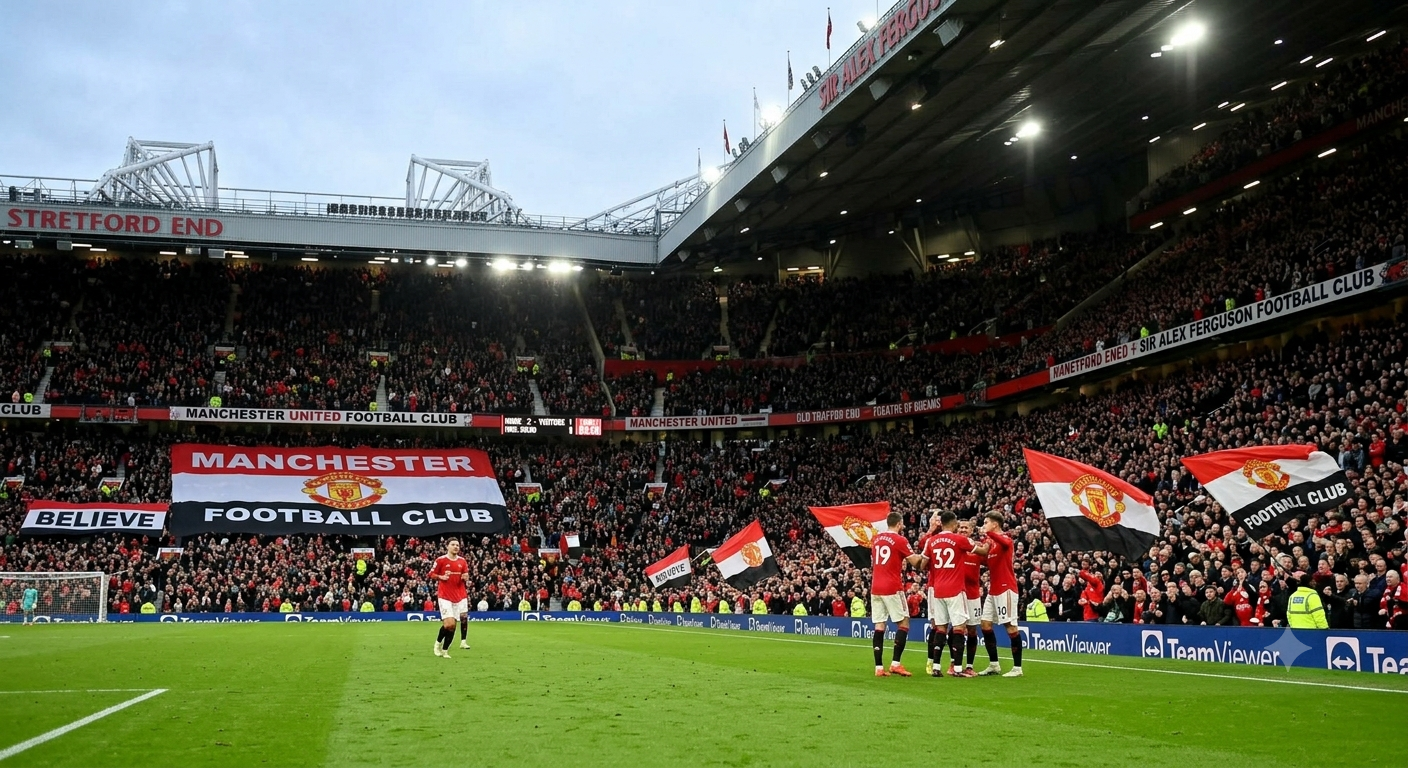
Simultaneously, Ratcliffe established a high-profile task force to address the long-neglected stadium infrastructure. Old Trafford, once the premier stadium in the country, had suffered from two decades of structural neglect, famously plagued by a leaking roof.
The task force evaluated two primary options: a comprehensive, multi-million-pound renovation of the existing historic structure, or the construction of a brand-new, state-of-the-art stadium with a capacity of 100,000 spectators on adjacent land owned by the club. Dubbed the “Wembley of the North,” this ambitious project aims to create an architectural marvel that will anchor a massive multi-billion-pound urban regeneration zone in Greater Manchester, secure the club’s financial future for the next half-century, and restore the Theatre of Dreams to its rightful status as a world-class arena.
SECTION VII: THE SOUL OF UNITED — ACADEMY, TRADITIONS, AND RIVALRIES
The Historic Academy Record
The true soul of Manchester United resides within its historic youth academy. The club holds an absolutely unparalleled, historic record in world football: since October 30, 1937, every single first-team matchday squad selected by Manchester United has included at least one homegrown academy graduate. This extraordinary streak spans over 4,000 consecutive competitive matches and more than 85 years of football history.
[October 30, 1937] ─────────────────────────────────────────────► [Present Day]
      │                                                                 │
      └─────────────────── OVER 4,000 CONSECUTIVE MATCHES ──────────────┘
                    (Every single matchday squad features
                     at least one Academy graduate)
From the post-war brilliance of Sir Bobby Charlton and Duncan Edwards, through the generational excellence of the Class of ’92, to the modern brilliance of Marcus Rashford, Alejandro Garnacho, and Kobbie Mainoo, the club’s institutional philosophy dictates that if a young player is good enough, they are old enough.
The DNA: Attacking Wing Play and Dramatic Resiliency
Tactically, the historic identity of Manchester United is permanently bound to an expressive, risk-taking, attacking philosophy. The system relies traditionally on lightning-fast, direct wing play. The history of the club is defined by iconic wingers—Billy Meredith, George Best, Steve Coppell, Andrei Kanchelskis, Ryan Giggs, David Beckham, and Cristiano Ronaldo—who look to isolate full-backs, deliver crosses, and drive into the penalty box.
Furthermore, the club possesses a deeply ingrained cultural trait of dramatic resiliency, forever defined as “Fergie Time.” Born from the traumatic ashes of Munich and exemplified by the 1999 Champions League triumph, United teams are culturally conditioned to never accept defeat, routinely scoring late, dramatic winning goals in the dying seconds of matches through relentless, waves of attack.
The Battle Lines: Historic Rivalries
Manchester United’s history is forged through intense, visceral rivalries that reflect deep-seated geographical, economic, and sporting animosities.
                         [THE BATTLE LINES]
  ┌──────────────────────────────┼──────────────────────────────┐
  ▼                                                             ▼
[THE NORTH-WEST DERBY]                                      [THE MANCHESTER DERBY]
vs Liverpool FC                                             vs Manchester City FC
(Economic history & Title supremacy)                        (Geographical proximity & Power shifts)
1. The North-West Derby (vs. Liverpool FC)
This is arguably the most famous, fiercely contested fixture in English football. The rivalry transcends sport, rooted deeply in the nineteenth-century economic war between the two cities, when Manchester built the Manchester Ship Canal to bypass Liverpool’s port taxes. On the pitch, it is a war for historic English football supremacy. For decades, the two clubs have constantly traded blows to claim the title of the most successful club in English football history.
2. The Manchester Derby (vs. Manchester City FC)
A fierce battle for local geographical dominance. Historically, United viewed City with a degree of patrician disdain, famously labeled by Sir Alex Ferguson as the “noisy neighbors.” However, the multi-billion-pound Abu Dhabi takeover of Manchester City in 2008 fundamentally altered the landscape, transforming the local derby into a high-stakes battle for domestic and global supremacy.
3. The Roses Rivalry (vs. Leeds United)
Rooted deep in the historical fifteenth-century War of the Roses between the Houses of Lancaster (red rose) and York (white rose), this fixture is characterized by intense atmospheric hostility and physical matches, epitomized by the fierce midfield wars between Roy Keane and Alf-Inge Haaland in the late 1990s.
CONCLUSION: THE ENDURING MYTHOS OF THE RED DEVILS
Manchester United Football Club remains one of the most compelling narratives in the history of modern sport. Its story is not merely a clinical list of statistical data, balance sheets, or silverware. Instead, it is a grand footballing epic—an institution built by working-class railwaymen, saved by a stray dog, brought to the absolute peak of domestic prominence by Matt Busby, completely devastated by the unimaginable tragedy of Munich, resurrected to achieve European glory, plunged into a two-decade wilderness, and driven to unprecedented heights of global sporting dominance by the iron fist of Sir Alex Ferguson.
As the club navigates the modern complexities of twenty-first-century ownership, tactical paradigms, and stadium redevelopment under INEOS guidance, the core institutional mythos of the club remains entirely unchanged.
Manchester United remains defined by its red shirts, its unyielding faith in youth, its refusal to accept defeat, and the roaring echoes of Old Trafford—the Theatre of Dreams.
                        [MANCHESTER UNITED FC]
                                │
       ┌────────────────────────┼────────────────────────┐
       ▼                        ▼                        ▼
  [THE PAST]               [THE PRESENT]            [THE FUTURE]
Industrial Soot           INEOS Restructure      100,000 Capacity
& Munich Resilience      & Tactical Overhaul     "Wembley of the North"