Here is the comprehensive, deep-dive history of FC Bayern Munich, tracking its journey from a small rebel club in Munich to an absolute powerhouse of world football.
1. The Foundation and Early Struggles (1900–1932)
FC Bayern Munich was born out of a rebellion. On February 27, 1900, members of the Munich gymnastics club MTV 1879 held a meeting. When the club’s management refused to allow the football faction to join the German Football Association (DFB), 11 players—led by Berlin native Franz John—walked out. They gathered at the Gisela Restaurant in Munich that very evening and signed the foundation charter for Schwabinger Fotball-Club Bayern, which later became FC Bayern München.
- Early Success: The club adopted white and blue as its initial colors (switching to red and white in 1906 after merging with Münchner Sport-Club). Bayern quickly became a dominant force in local Bavarian leagues.
- The First National Title (1932): Led by Jewish president Kurt Landauer and visionary Austrian coach Richard “Dombi” Kohn, Bayern achieved its first major milestone by winning the German National Championship in 1932, defeating Eintracht Frankfurt 2–0 in the final.
2. The Dark Years: Nazi Regime and WWII (1933–1945)
The rise of Adolf Hitler and the Nazi Party in 1933 brought a sudden, tragic halt to Bayern’s early golden era.
- The “Jew’s Club” (Judenklub): Because of President Landauer and Coach Dombi’s Jewish heritage, the totalitarian regime heavily targeted Bayern Munich. Landauer was forced to resign and was briefly imprisoned in the Dachau concentration camp before escaping into exile in Switzerland.
- Decline and Survival: While their local rivals TSV 1860 Munich embraced the Nazi regime and flourished with state backing, Bayern was marginalized. The club lost its top status, and during World War II, many players were conscripted into the military, leaving the club in a state of survival rather than competition.
3. Post-War Recovery and Bundesliga Snub (1945–1963)
Following the collapse of the Nazi regime, Kurt Landauer returned from exile to rebuild the club from literal ruins.
- Rebuilding Phase: Bayern played in the Oberliga Süd (Southern League). While they won their first-ever DFB-Pokal (German Cup) in 1957 by beating Fortuna Düsseldorf 1–0, financial instability continued to plague the club.
- The 1963 Bundesliga Snub: When the DFB founded Germany’s first centralized professional league, the Bundesliga, in 1963, Bayern Munich was shockingly excluded. The DFB ruled that only one club per city could join, and because 1860 Munich had won the Oberliga that year, they were picked over Bayern. This snub turned out to be a blessing in disguise, forcing Bayern to rely heavily on young, local talent.
4. The Golden Era: Ruling Europe (1965–1979)
Bayern gained promotion to the Bundesliga in 1965 with a squad composed of exceptionally talented youngsters who would change football history forever.
The Axis of Greatness
This era was defined by three generational talents, often referred to as the club’s holy trinity:
- Franz Beckenbauer (“Der Kaiser”): The elegant sweeper who revolutionized the “Libero” role and became the tactical mastermind on the pitch.
- Gerd Müller (“Der Bomber”): Arguably the greatest pure goalscorer in football history, setting records that stood for decades.
- Sepp Maier: A legendary, agile, and charismatic goalkeeper.
The European Treble
Under coaches Udo Lattek and later Dettmar Cramer, Bayern went from domestic cup winners to kings of Europe:
- 1969: Bayern won their first Bundesliga title and the DFB-Pokal, completing their first domestic Double.
- European Cup Hat-Trick (1974, 1975, 1976): Bayern dominated the continent by winning three consecutive European Cups (now the UEFA Champions League), defeating Atletico Madrid, Leeds United, and Saint-Étienne, respectively.
5. “FC Hollywood” and Continental Heartbreak (1980–1999)
The 1980s and 1990s were decades of transition, heavy domestic dominance, but chaotic off-pitch drama.
- The Rise of Uli Hoeness: After injuries ended his playing career, Uli Hoeness became the club’s general manager at just 27 years old. He transformed Bayern from a financially unstable club into a commercial juggernaut.
- The “FC Hollywood” Era: During the 1990s, under coaches like Giovanni Trapattoni and Otto Rehhagel, the club was filled with superstars (Lothar Matthäus, Jürgen Klinsmann, Stefan Effenberg) whose egos, public feuds, and tabloid drama earned the club the nickname “FC Hollywood.”
- The 1999 Barcelona Tragedy: In the 1999 Champions League Final against Manchester United, Bayern led 1–0 until the 91st minute. In one of the most agonizing finishes in sports history, United scored two goals in injury time, leaving the Bayern players shattered on the pitch.
6. Redemption and the Modern Powerhouse (2000–2012)
Bayern entering the 21st century was defined by a burning desire to avenge the 1999 tragedy.
- 2001 Champions League: Led by the fiery goalkeeper Oliver Kahn and coach Ottmar Hitzfeld, Bayern finally won the Champions League again in 2001, defeating Valencia on penalties.
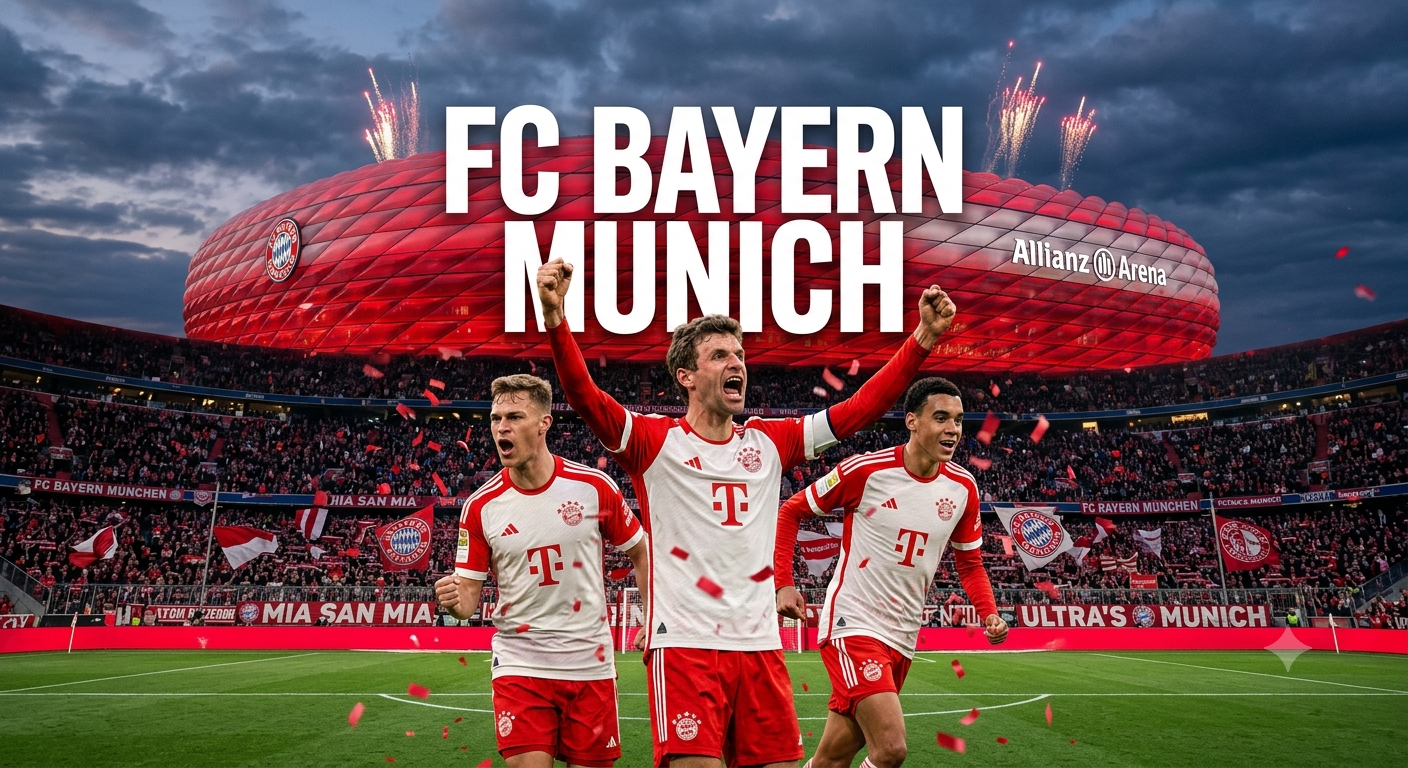
- The Allianz Arena: In 2005, Bayern moved out of the historic Olympic Stadium into their ultra-modern, state-of-the-art home, the Allianz Arena, solidifying their financial independence.
- The “Robbery” Era: The signings of Franck Ribéry (2007) and Arjen Robben (2009) gave Bayern one of the most lethal winger duos in football history.
- The “Finale Dahoam” Heartbreak (2012): In 2012, Bayern reached the Champions League final, hosted in their own stadium in Munich. Despite dominating Chelsea, they lost on penalties—a devastating blow known as the “Drama at Home.”
7. The Trebles and Unprecedented Dominance (2013–Present)
True to the club’s motto, “Mia San Mia” (We Are Who We Are), Bayern bounced back from the 2012 heartbreak to launch the most dominant decade in German football history.
The 2013 Treble
Under legendary coach Jupp Heynckes, the 2012–13 Bayern squad played a flawless brand of high-pressing football. They avenged their previous losses by beating arch-rivals Borussia Dortmund 2–1 in the Wembley Champions League Final, securing their first-ever Continental Treble (Bundesliga, DFB-Pokal, and Champions League).
The Pep Guardiola Era (2013–2016)
Pep Guardiola took over and evolved the team’s tactical identity, instilling a relentless possession-based style. While European glory eluded him, he dominated the Bundesliga, winning three consecutive league titles in record-breaking fashion.
The 2020 Sextuple
In the 2019–20 season, under Hansi Flick, Bayern assembled another historic run. Fueled by the lethal goalscoring of Robert Lewandowski (who broke Gerd Müller’s single-season record with 41 goals in 2021), Bayern went undefeated in the Champions League, defeating PSG 1–0 in the final. They went on to win all six available trophies in a single calendar year (The Sextuple), matching Barcelona’s historic feat.
11 in a Row and Beyond
Bayern accomplished a feat never before seen in Europe’s top five leagues by winning 11 consecutive Bundesliga titles from 2013 to 2023. Even as the landscape of European football evolves with massive state-backed clubs, FC Bayern Munich remains a fan-owned, financially stable global super-club built on a foundation of resilience, brilliant youth integration, and an uncompromising winning mentality.