Introduction: The Birth of a Titan (1902–1920)
The story of Real Madrid Club de Fútbol began in the late 19th century when football was introduced to Madrid by academics and students, many of whom had studied in the United Kingdom. They formed a loose collective known as Sky Football in 1897. However, internal disagreements led to a split, and on March 6, 1902, a new club was officially established under the name Madrid Foot-Ball Club.
The club’s first president was Juan Padrós, a Catalan businessman who, along with his brother Carlos, drafted the institution’s initial statutes. From its very inception, Madrid FC wore an all-white kit, a choice inspired by the English club Corinthian FC, known for its sportsmanship and elegant play.
[1902: Founded as Madrid FC] ──> [1905: First Copa del Rey] ──> [1920: Granted "Real" Title]
Madrid FC wasted little time in establishing its competitive dominance. In 1905, only three years after its founding, the club won its first major title by defeating Athletic Bilbao in the Copa del Rey final. This was the beginning of a dominant era in the national cup, with Madrid winning four consecutive Copa del Rey titles between 1905 and 1908.
In 1920, the club underwent a historic transformation. King Alfonso XIII, an avid sportsman, granted the club royal patronage. The title “Real” (Royal) was prefixed to the club’s name, and the royal crown was added to its official crest. Although the proclamation of the Second Spanish Republic in 1931 temporarily stripped the club of its royal title and crown, the identity of “Real Madrid” was already deeply woven into the fabric of Spanish sports.
The Darkest Years and Reconstruction (1931–1953)
The 1930s brought unprecedented turmoil to Spain, and Real Madrid was not spared. Despite winning its first two La Liga titles in 1932 and 1933 under the stewardship of legendary goalkeeper Ricardo Zamora, the onset of the Spanish Civil War (1936–1939) brought competitive football to a devastating halt.
During the war, the club’s stadium was damaged, its membership plummeted, and many players and staff members were displaced, exiled, or killed. The club was on the brink of total collapse.
   ┌────────────────────────────────────────┐
   │       THE CIVIL WAR CRISIS (1936)      │
   └───────────────────┬────────────────────┘
                       ▼
   ┌────────────────────────────────────────┐
   │ Stadium Damaged & Archives Destroyed   │
   └───────────────────┬────────────────────┘
                       ▼
   ┌────────────────────────────────────────┐
   │ 1943: Santiago Bernabéu Elected Pres.  │
   └────────────────────────────────────────┘
The turning point in the club’s modern history occurred in 1943 when Santiago Bernabéu Yeste was elected club president. Bernabéu, a former player, captain, and manager, undertook a massive, visionary reconstruction project. He recognized that to become a world-class club, Real Madrid needed world-class infrastructure.
- 1947: Bernabéu inaugurated the massive Nuevo Estadio Chamartín, which was later renamed the Santiago Bernabéu Stadium in his honor.
- 1948: He established the club’s pioneering youth academy system, La Fábrica, and built advanced training facilities.
Despite these infrastructure successes, Real Madrid struggled on the pitch during the 1940s, watching rivals like Atletico Madrid, Barcelona, and Valencia dominate La Liga. Bernabéu knew that infrastructure alone wasn’t enough; he needed a sporting revolution.
The Golden Era and the Di Stéfano Revolution (1953–1964)
The year 1953 is arguably the most critical inflection point in football history. Real Madrid secured the signing of Argentine maestro Alfredo Di Stéfano after a highly controversial and complex transfer dispute with Barcelona.
Di Stéfano, known as “La Saeta Rubia” (The Blond Arrow), revolutionized how football was played. He was a total footballer—defending, organizing, and scoring at will. Alongside Hungarian wizard Ferenc Puskás, French winger Raymond Kopa, and Spanish speedster Francisco “Paco” Gento, Real Madrid built an unstoppable attacking machine.
      THE FIVE EUROPEAN CUPS (1956–1960)
┌──────┬──────────────────────────────┬────────┐
│ Year │ Opponent                     │ Result │
├──────┼──────────────────────────────┼────────┤
│ 1956 │ Stade de Reims               │  4–3   │
│ 1957 │ Fiorentina                   │  2–0   │
│ 1958 │ AC Milan                     │  3–2   │
│ 1959 │ Stade de Reims               │  2–0   │
│ 1960 │ Eintracht Frankfurt          │  7–3   │
└──────┴──────────────────────────────┴────────┘
When Gabriel Hanot, an editor for the French newspaper L’Équipe, proposed the creation of a continental tournament to crown the best club in Europe, Santiago Bernabéu immediately championed the idea. The European Champion Clubs’ Cup (now the UEFA Champions League) was born in the 1955–56 season.
Real Madrid completely dominated the early years of the competition:
- 1956: Fought back to defeat Stade de Reims 4–3 in Paris.
- 1957: Beat Fiorentina 2–0 in front of 120,000 fans at the Bernabéu.
- 1958: Overcame AC Milan 3–2 in a thrilling extra-time battle.
- 1959: Defeated Reims once again, 2–0 in Stuttgart.
- 1960: Delivered what is widely considered the greatest football match ever played, defeating Eintracht Frankfurt 7–3 at Hampden Park, Glasgow, featuring a hat-trick by Di Stéfano and four goals from Puskás.
This unprecedented run of five consecutive European titles established Real Madrid as the premier powerhouse of global football, earning them the permanent possession of the original trophy and setting a standard of excellence that defined the club’s DNA.
The Yé-Yé Generation and Domination in Spain (1964–1980)
As the legendary figures of the 1950s aged out, Real Madrid transitioned into a new era. By the mid-1960s, manager Miguel Muñoz constructed a team composed entirely of native Spanish players. This team became affectionately known as the “Yé-Yé” generation, a name derived from the chorus of The Beatles’ hit song “She Loves You” (Yeah, Yeah, Yeah), reflecting the hip, youthful culture of the era.
Led by veteran Paco Gento and young stars like Amancio Amaro, Pirri, Manuel Sanchís Sr., and Ignacio Zoco, this energetic side proved the skeptics wrong by capturing Real Madrid’s sixth European Cup in 1966, defeating Partizan Belgrade 2–1 in Brussels. With this victory, Paco Gento set an astonishing record as the only player in history to win six European Cups—a record that stood for nearly six decades.
[1960s Yé-Yé Era] ──> All-Spanish Squad ──> Won 1966 European Cup
While continental success became harder to come by in the 1970s due to the rise of Johan Cruyff’s Ajax and Franz Beckenbauer’s Bayern Munich, Real Madrid remained utterly dominant within Spain. They captured six La Liga titles during the 1970s.
However, the era ended in deep mourning. On June 2, 1978, during the World Cup in Argentina, iconic club president Santiago Bernabéu passed away. His death marked the end of a 35-year presidency during which he transformed Real Madrid from a war-torn club into the most successful sporting institution in the world.
La Quinta del Buitre and Domestic Hegemony (1980–1990)
The early 1980s were lean years for Madrid, highlighted by a painful loss to Liverpool in the 1981 European Cup final. However, salvation was brewing within the club’s own youth academy.
By the mid-1980s, a remarkable crop of five homegrown Spanish talents graduated to the first team. They were led by a charismatic, clinical striker named Emilio Butragueño, nicknamed “El Buitre” (The Vulture). The group, collective dubbed La Quinta del Buitre (The Vulture’s Cohort), consisted of:
- Emilio Butragueño (The cerebral forward)
- Míchel (The elegant right winger)
- Manolo Sanchís (The rock-solid central defender)
- Martín Vázquez (The technically gifted midfielder)
- Miguel Pardeza (The agile forward)
Supported by international stars like Mexican goal-machine Hugo Sánchez (who won five Pichichi trophies) and Argentine midfielder Jorge Valdano, La Quinta del Buitre played a breathtaking, highly offensive brand of football.
       DOMESTIC DOMINANCE (1985–1990)
┌────────────────────────────────────────────┐
│ • 5 Consecutive La Liga Titles (Record)    │
│ • 2 Back-to-Back UEFA Cups (1985, 1986)    │
│ • Iconic European Comebacks ("Remontadas") │
└────────────────────────────────────────────┘
They completely monopolized Spanish football, winning five consecutive La Liga titles between 1986 and 1990. They also conquered Europe by winning back-to-back UEFA Cups in 1985 and 1986. This era firmly cemented the legendary mythos of the Santiago Bernabéu remontada (comeback), where the team routinely overturned massive first-leg deficits in European home games, fueled by an intimidating, roaring stadium atmosphere. Despite their domestic omnipotence, this brilliant generation famously missed out on the European Cup, repeatedly falling short in the semi-finals.
Reclaiming the European Throne (1990–2000)
The 1990s began under the shadow of Johan Cruyff’s Barcelona “Dream Team,” which won four consecutive league titles. Real Madrid suffered agonizing heartbreaks, losing two consecutive league titles on the final day of the season to Tenerife in 1992 and 1993.
However, the tides turned in the mid-90s. Under manager Jorge Valdano, Madrid reclaimed the league title in 1995, powered by Danish playmaker Michael Laudrup and a prolific Chilean striker named Ivan Zamorano. It was also during this season that Valdano handed a debut to a 17-year-old academy prodigy: Raúl González Blanco. Raúl would go on to become the timeless symbol, captain, and soul of the club for the next fifteen years.
   THE SEARCH FOR "LA SÉPTIMA"
[1966: 6th Title] ──( 32-Year Drought )──> [1998: 7th Title (La Séptima)]
The defining moment of the decade arrived in 1998. Real Madrid reached the UEFA Champions League final in Amsterdam against a heavily favored Juventus side featuring Zinedine Zidane. In the 66th minute, Yugoslav forward Predrag Mijatović latched onto a deflected shot, rounded the keeper, and slotted the ball home from a tight angle.
The match ended 1–1, breaking a grueling 32-year European drought. Real Madrid had finally captured their seventh European crown: La Séptima.
Two years later, under the calm management of club veteran Vicente del Bosque, Real Madrid won La Octava (the 8th) in the year 2000, convincingly defeating Valencia 3–0 in the first-ever single-country Champions League final in Paris, with stars like Raúl, Fernando Redondo, and a young Iker Casillas leading the charge.
The Galácticos Era (2000–2006)
In July 2000, a wealthy civil engineer named Florentino Pérez was elected club president, promising to fix the club’s financial debts and execute a revolutionary sporting policy: Los Galácticos. Pérez’s philosophy was simple yet audacious—sign the world’s biggest, most marketable superstars every single summer, combining them with academy graduates (Zidanes y Pavones).
          THE GALÁCTICO TIMELINE
┌──────┬──────────────────┬────────────────────────┐
│ Year │ Player Signed    │ From                   │
├──────┼──────────────────┼────────────────────────┤
│ 2000 │ Luís Figo        │ Barcelona (Rival Jump) │
│ 2001 │ Zinedine Zidane  │ Juventus (Record Fee)  │
│ 2002 │ Ronaldo Nazário  │ Inter Milan            │
│ 2003 │ David Beckham    │ Manchester United      │
└──────┴──────────────────┴────────────────────────┘
The era launched with the highly controversial signing of Luís Figo directly from arch-rivals Barcelona. This was followed by the signing of maestro Zinedine Zidane in 2001 for a world-record fee.
The absolute sporting zenith of this era occurred in the 2002 UEFA Champions League Final in Glasgow. Tied 1–1 against Bayer Leverkusen, Zinedine Zidane tracked a high, looping cross from Roberto Carlos and struck a flawless, gravity-defying left-footed volley into the top corner. It is widely heralded as the greatest goal in Champions League history, securing Real Madrid’s ninth European title: La Novena.
Following the Champions League triumph, Brazilian phenom Ronaldo arrived in 2002, followed by English pop-culture icon David Beckham in 2003. While the Galácticos generated unprecedented global marketing revenue, worldwide fans, and sold-out stadiums, the squad became unbalanced defensively after the departure of defensive midfielder Claude Makélélé and coach Vicente del Bosque. The project eventually stalled, leading to a three-year trophy drought and Florentino Pérez’s resignation in 2006.
The Guard of Honor and Rebuilding (2006–2009)
Under new president Ramón Calderón and pragmatic Italian manager Fabio Capello, Real Madrid underwent a gritty, character-driven restructuring. The 2006–07 season became legendary as the Liga de las Remontadas. Powered by the clinical finishing of Ruud van Nistelrooy and the leadership of Raúl, Madrid staged multiple dramatic, late-game comebacks to snatch the La Liga title away from Barcelona on the final matchday.
[2007: La Liga Champions] ──> [2008: Back-to-Back Titles & Camp Nou Guard of Honor]
The following year (2007–08), under German coach Bernd Schuster, Real Madrid successfully defended their league title with ease. The iconic moment of this period occurred during El Clásico at the Santiago Bernabéu, when Barcelona players were forced to perform a traditional Guard of Honor (pasillo) to welcome the newly crowned champions Real Madrid onto the pitch before a resounding 4–1 Madrid victory.
However, the club hit a glass ceiling in Europe, suffering six consecutive eliminations in the Champions League Round of 16. This prompted the return of the visionary builder.
The Cristiano Ronaldo Era and La Décima (2009–2018)
In 2009, Florentino Pérez returned to the presidency with an appetite for records. In a single summer transfer window, he smashed the world transfer record twice, signing Brazilian playmaker Kaká and Portuguese superstar Cristiano Ronaldo from Manchester United, alongside Karim Benzema and Xabi Alonso.
               CRISTIANO RONALDO RECORDS
┌────────────────────────────────────────────────────────┐
│ • 450 Goals in 438 Appearances (All-Time Top Scorer)   │
│ • 4 UEFA Champions League Titles                       │
│ • 4 Ballon d'Or Awards while at the club              │
└────────────────────────────────────────────────────────┘
This sparked an era of unprecedented rivalry against Pep Guardiola’s Barcelona. In 2010, José Mourinho was brought in as manager to stop the Catalan dominance. Mourinho injected ruthless intensity, winning an epic Copa del Rey final against Barcelona in 2011 and capturing the 2011–12 “Records League” title, where Real Madrid set historic, all-time La Liga benchmarks by amassing 100 points and scoring 121 goals.
The Obsession: La Décima (2014)
For twelve long years, Real Madrid was obsessed with winning its tenth European Cup. Under Italian manager Carlo Ancelotti in 2014, the club finally reached the final in Lisbon, facing city rivals Atlético Madrid.
By the 93rd minute, Real Madrid was trailing 1–0, and the dream seemed dead. Then came the most famous minute in modern Madrid history: 92:48. Sergio Ramos rose majestically to meet a Luka Modrić corner, powering a bullet header past Thibaut Courtois into the bottom corner. A devastated Atlético collapsed in extra time, and Real Madrid cruised to a 4–1 victory. La Décima was finally reality.
93rd Minute Corner ──> Sergio Ramos Header (92:48) ──> Extra-Time Victory (4–1)
The Three-Peat (2016–2018)
In January 2016, former club legend Zinedine Zidane was appointed head coach. What followed defied modern footballing logic.
[2016 Champions League] ──> [2017 Champions League] ──> [2018 Champions League]
               🏆 THREE-PEAT CHAMPIONS 🏆
Zidane fostered unparalleled squad harmony, relying on the legendary midfield trio of Luka Modrić, Toni Kroos, and Casemiro (affectionately dubbed the Bermuda Triangle), flanked by the lightning pace of Gareth Bale and the lethal finishing of Cristiano Ronaldo. Real Madrid achieved a modern sporting miracle:
- 2016: Defeated Atlético Madrid on penalties in Milan.
- 2017: Crushed Juventus 4–1 in Cardiff, becoming the first team in the modern Champions League era to retain the trophy.
- 2018: Defeated Liverpool 3–1 in Kyiv, highlighted by a breathtaking overhead bicycle kick by Gareth Bale.
Zidane’s Madrid won three consecutive UEFA Champions League titles, a feat completely unmatched in the modern era of sports.
The New Era: Transition and Continued Glory (2018–2026)
The summer of 2018 saw the departures of both Zinedine Zidane and Cristiano Ronaldo, who left as the club’s all-time leading scorer with an astonishing 450 goals in 438 games. Many pundits predicted a lengthy decline, but Real Madrid’s institutional structure proved resilient.
         THE SEAMLESS TRANSITION
Homegrown/Young Core          Veteran Leadership
• Vinícius Júnior             • Karim Benzema
• Rodrygo Goes                • Luka Modrić
• Jude Bellingham             • Dani Carvajal
French forward Karim Benzema stepped completely out of Ronaldo’s shadow, transforming into a lethal talisman. Alongside a core of aging greats and explosive young Brazilian wingers Vinícius Júnior and Rodrygo, Carlo Ancelotti returned for a second managerial stint in 2021.
The 2021–22 Champions League campaign entered folklore as a series of impossible escapes. Real Madrid staged miraculous, late-game knockout stage comebacks against Paris Saint-Germain, Chelsea, and Manchester City—where Rodrygo scored two goals in 84 seconds in the 90th minute to force extra time. Real Madrid defeated Liverpool 1–0 in Paris to secure La Decimocuarta (the 14th European title), and Karim Benzema was justly rewarded with the 2022 Ballon d’Or.
   2022 CHAMPIONS LEAGUE RUN OF MIRACLES
┌─────────────────┬──────────────────────────────────┐
│ Opponent        │ The Comeback                     │
├─────────────────┼──────────────────────────────────┤
│ PSG             │ Benzema 17-minute hat-trick      │
│ Chelsea         │ Rodrygo late volley, Modric pass │
│ Manchester City │ Rodrygo scores twice in 90th min │
└─────────────────┴──────────────────────────────────┘
Concurrently, Florentino Pérez undertook a multi-billion euro technological overhaul of the Santiago Bernabéu Stadium, transforming it into a futuristic, hyper-modern architectural marvel featuring a fully retractable pitch and a 360-degree video scoreboard.
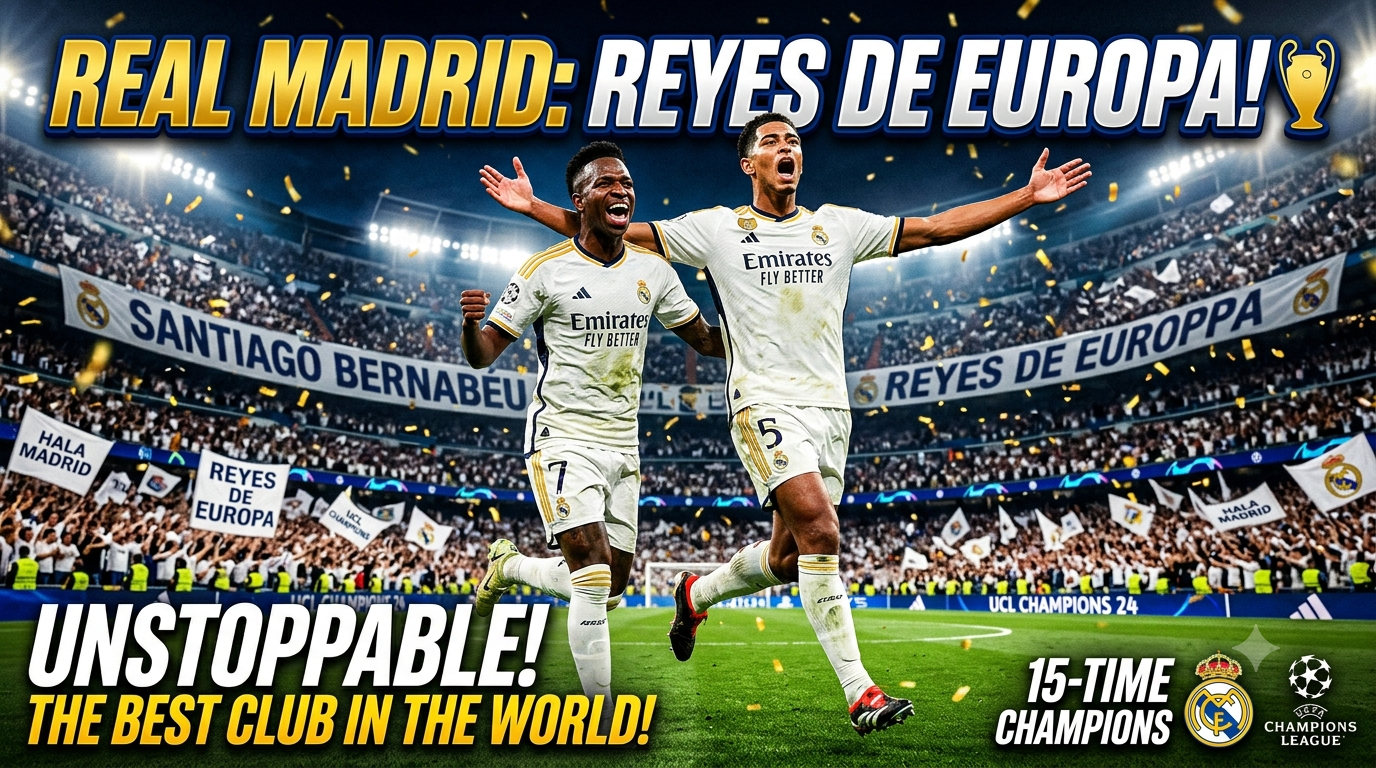
The club also seamlessly integrated a new generation of elite global talents, spearheaded by French powerhouse Aurélien Tchouaméni, midfield engine Eduardo Camavinga, and the sensational English midfielder Jude Bellingham, who enjoyed a historic debut season in 2023–24, culminating in a dominant La Liga and La Decimoquinta (the 15th Champions League) double.
The Crest, Culture, and Institutional Identity
Real Madrid’s historical greatness is built on a distinct philosophy: an uncompromising, insatiable hunger for victory, a refusal to accept defeat (“Hasta el final, vamos Real”), and a unique institutional design.
              CLUB BREAKDOWN
┌───────────────────┬───────────────────────────────┐
│ Metric            │ Value / Type                  │
├───────────────────┼───────────────────────────────┤
│ Ownership Model   │ Fan-owned (Socios)            │
│ Main Rivals       │ Barcelona, Atlético Madrid    │
│ FIFA Award        │ Club of the Century (20th)    │
└───────────────────┴───────────────────────────────┘
Unlike most modern elite football clubs owned by foreign billionaires or state funds, Real Madrid is owned and operated entirely by its 90,000+ club members (socios). The members democratically elect the club president, ensuring the institution remains tethered to its community and heritage.
The club’s cultural impact is magnified by its intense rivalries:
- El Clásico: The biannual battle against Barcelona, reflecting deep-seated regional, cultural, and political contrasts within Spain, viewed by hundreds of millions globally.
- El Derbi Madrileño: The fierce local civil war against Atlético Madrid, traditionally pitting the royal, elite identity of Real against the gritty, working-class ethos of Atlético.
The Ultimate Trophy Cabinet
The unmatched success of Real Madrid is best quantified by its trophy cabinet, leading FIFA to officially name it the FIFA Club of the Century for the 20th century.
- UEFA Champions League / European Cup: 15 (All-time Record)
- La Liga: 36 (All-time Record)
- Copa del Rey: 20
- FIFA Club World Cup / Intercontinental Cup: 8 (All-time Record)
- UEFA Super Cup: 6 (All-time Record)
- Supercopa de España: 13
“Real Madrid is a myth, an institution that surpasses names, eras, and generations. It is a white shirt that demands nothing less than immortality from those who wear it.”
— Santiago Bernabéu Yeste